
Claim Your Free Estimate Today
Table of Contents
- Why Homeowners Switch From Goettl to Local Plumbing Services
- What to Compare When Choosing a Plumbing Services Provider
- Key Questions to Ask a Plumber Before You Commit
- Understanding Your Plumbing Repair Estimate
- How a Sewer Camera Inspection Diagnoses Problems
- Drain Cleaning Services: Methods and When You Need Them
- Conclusion
- Frequently Asked Questions
Last Updated: October 6, 2026
Why Homeowners Switch From Goettl to Local Plumbing Services
Homeowners searching for a Goettl alternative for plumbing services want faster emergency response, transparent pricing, or a company that treats their home like it matters. Goettl’s national scale comes with trade-offs; local providers often deliver personal attention, faster dispatch, and technicians who know your area’s plumbing challenges.
Homeowners dealing with burst pipes, sewer backups, or aging plumbing often prefer a locally owned company that answers the phone with a real person, not an automated system.
This guide covers what matters when comparing plumbing services: questions to ask, how to read an estimate, and red flags that separate reliable operators from ones you’ll regret calling.
What to Compare When Choosing a Plumbing Services Provider
Not all plumbing services are built the same. A company that handles routine faucet repairs might fall apart on emergency sewer work. Before you commit, evaluate them across these dimensions.
Service Coverage and Emergency Availability
Plumbing emergencies don’t wait for business hours. When comparing a Goettl alternative for plumbing services, ask directly: Do they offer 24/7 emergency service, and how fast do they actually arrive?
National chains advertise 24/7 availability, but response times vary with call volume and technician proximity.
Ask: “If I call at 3 a.m. with a burst pipe, how long until someone arrives?” Vague hedging means they’re managing expectations downward.
Emergency availability also matters for your specific problem. Some plumbers handle drain cleaning but won’t touch water heater replacement; others treat residential calls as a sideline. Ask what emergencies they handle most frequently and whether technicians cover your issue.
Licensing, Insurance, and Professional Qualifications
A licensed plumber has passed exams and meets state requirements. Unlicensed operators cut corners, and you’ll pay when the job fails.
In most states, plumbers must hold a journeyman or master license. Ask to see proof, don’t accept verbal assurance; legitimate companies display their license number on their website and trucks.
When evaluating a Goettl alternative for plumbing services, verify licensing through your state’s licensing board, five minutes online catches unlicensed operators.
Qualifications go beyond licensing. Has the company invested in diagnostic equipment like sewer cameras instead of guessing? Do they offer trenchless sewer repair that avoids tearing up your yard?
Warranty and Service Guarantees
What happens if the problem returns in six months? Ask explicitly: Do they guarantee repairs for a specific period, and what does the warranty cover?
Most reputable plumbing companies offer at least a one-year warranty on parts and labor, some longer. Parts-only doesn’t protect you if installation fails, and labor-only doesn’t cover defective parts, you want both.
Also ask about complaint resolution: if something goes wrong, can you reach the owner directly or are you stuck in a phone tree? A confident answer suggests few complaints to begin with.
Key Questions to Ask a Plumber Before You Commit
Before you hire anyone, ask these questions. The answers reveal how a company actually operates.
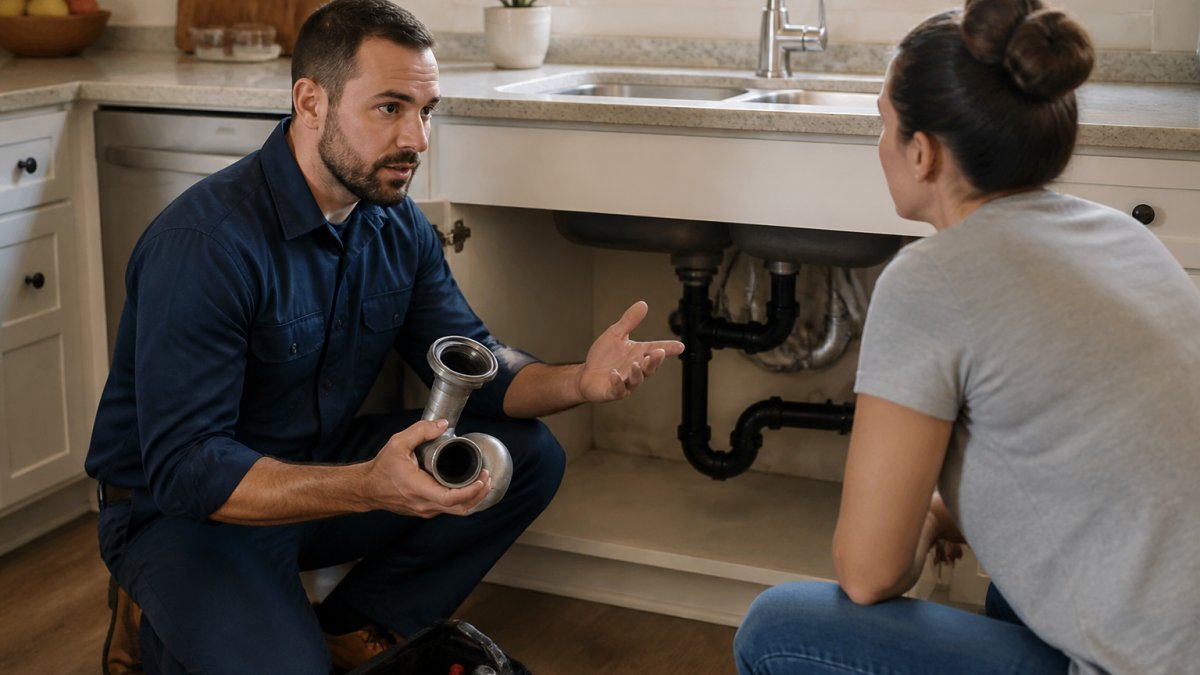
“Can you give me a written estimate before starting work?” A written estimate includes scope, materials, labor costs, and timeline, protecting both of you.
“Do you charge for the service call or estimate?” Most local plumbers offer free estimates. If they charge, the fee should apply to the final bill if you hire them.
“How do you diagnose problems?” Do they use diagnostic equipment like sewer cameras, or rely on guesswork? For drain issues, sewer backups, or water line problems, a camera inspection is the professional standard, it shows exactly what’s wrong.
“What’s your experience with my specific problem?” For water heater replacement, ask how many they’ve done; for main line repair, ask about trenchless methods.
“Do you offer financing?” Major work like repiping or sewer line replacement can be expensive, and some companies offer financing for eligible projects.
Understanding Your Plumbing Repair Estimate
Most pages say “get a written estimate” and move on. That is the floor, not the ceiling. The useful skill is knowing what drives the number and how to compare two quotes that look nothing alike. Here is a framework for any Goettl alternative for plumbing services you are considering.
The cost drivers behind almost every plumbing quote
Plumbing pricing is not random. It moves with a handful of variables, and knowing them lets you sanity-check any number:
- Access and excavation. A repair under a slab, behind a finished wall, or beneath a driveway costs far more than the same repair in an open basement or crawlspace. Restoration, patching drywall, pouring concrete, replacing tile, is often a separate line and sometimes a separate trade.
- Pipe material and diameter. Replacing a section of galvanized steel is not priced like replacing cast iron or PVC. Larger-diameter main lines carry higher material costs.
- Method. Trenchless repair (pipe lining or pipe bursting) typically costs more per foot than open-cut excavation but avoids landscaping and hardscape restoration. The trade-off is often close to a wash once restoration is included.
- Time and urgency. After-hours, weekend, and holiday emergency calls carry premium rates. A job that can wait until Tuesday morning is usually cheaper than the same job at 2 a.m. on a Sunday.
- Permits and inspection. Work that requires a permit includes a fee and a scheduling dependency. Ask who pulls it and whether the fee is in the quote.
- Equipment. Water heater replacement, repiping, and sewer line work all involve different labor hours and specialty tools. A quote should reflect the actual scope, not a flat “plumbing” rate.
What a complete estimate should itemize
A vague estimate transfers risk from the contractor to you. A complete one breaks the job into recognizable parts:
Claim Your Free Estimate Today →
- Diagnosis, what was found and how (camera footage, pressure test, visual inspection).
- Scope of work, the specific repair or replacement, described in plain terms.
- Materials, pipe type, fittings, fixtures, and equipment, with brand or model where it matters.
- Labor, hours or a flat rate, and whether the rate changes after hours.
- Permits and inspection fees, listed separately if applicable.
- Restoration, what is and is not included (drywall, concrete, landscaping).
- Timeline, start date, expected duration, and what could extend it.
- Warranty, the length and what it covers (parts, labor, or both).
- Payment terms, deposit amount, progress payments, and accepted methods.
If a quote says “sewer repair: $X” with nothing behind it, ask for the breakdown. A company that can’t produce one is guessing or hiding margin.
How to compare two quotes fairly
Two estimates for the same problem rarely match line for line. Compare them on these axes instead of the bottom number:
| Comparison axis | What to check |
|---|---|
| Scope | Are both quotes solving the same problem, or is one a patch and the other a replacement? |
| Method | Open-cut vs. trenchless, snake vs. hydro jet, repair vs. replace |
| Materials | Same pipe material, same fixture grade, same equipment brand? |
| Restoration | Is cleanup and repair included, or billed separately? |
| Permits | Who pulls the permit, and is the fee in the quote? |
| Warranty | Length and coverage, parts only, labor only, or both? |
| Timeline | Same start window and duration, or is one quoting a faster turnaround? |
| Payment | Deposit size, financing availability, and cancellation terms |
A lower number on a narrower scope isn’t a better deal, it’s a different job.
Reading the fine print that changes the price
Three clauses deserve a second look before signing:
- Contingency language. A good estimate states what happens if the technician finds something unexpected, for example, “if root intrusion extends past the main line, we will provide a revised estimate before proceeding.” That protects you from open-ended charges.
- Diagnostic fees. Some companies charge a service call fee credited toward the repair if you hire them and forfeited if you don’t. Ask which model applies.
- Change-order process. Confirm, in writing, that no additional work proceeds without your approval and a revised estimate. Verbal approvals are how surprise bills happen.
Ask each company to quote the same scope in writing. When you control the scope, the quotes become comparable, and the conversation shifts from price to value.
Questions that surface hidden costs
Before accepting any estimate, ask:
- “Does this price include the permit and the inspection?”
- “Is restoration, drywall, concrete, landscaping, included, or is that a separate contractor?”
- “If you find a second problem while you are in there, how do you price it?”
- “Is the warranty on parts, labor, or both, and how long?”
- “What is the deposit, and when is the balance due?”
A company that answers these clearly is one you can hold to the number; one that deflects is telling you how the job will go.
The estimate is not a price, it is a scope document. Compare scopes first, then prices.
How a Sewer Camera Inspection Diagnoses Problems
When you have a clogged drain or sewer backup, the cause isn’t always obvious. A sewer camera inspection uses a waterproof camera on a flexible cable to look inside your pipes and identify the exact problem.
The technician inserts the camera into the cleanout (usually near your foundation or in the yard) and feeds it through the pipe, watching a live feed for blockages, cracks, root intrusion, or collapsed sections.
This prevents guessing.
A sewer camera inspection costs little compared to unnecessary repairs, making it one of the best diagnostic investments. Most reputable plumbing companies include it for sewer and drain issues.
Drain Cleaning Services: Methods and When You Need Them
Clogged drains and sewer backups are the most common plumbing emergencies. Understanding your options helps you decide.
Mechanical cleaning uses a plumbing snake or auger to break up the blockage.
Hydro jetting uses high-pressure water (up to 4000 psi) to blast away buildup, grease, roots, and debris, cleaning the entire pipe interior rather than just the clog.
Chemical drain cleaners from the hardware store are corrosive, dangerous to handle, and often fail on serious clogs. Professional plumbers rarely recommend them because they damage pipes over time and create safety hazards.
When do you need drain cleaning? Multiple slow or backing-up drains, or recurring clogs, need professional service, a sewer camera inspection shows whether it’s a simple clog or a deeper problem like root intrusion or a cracked pipe.
| Drain Problem | Recommended Method | Why |
|---|---|---|
| Single slow drain | Mechanical snake | Quick, inexpensive, effective for debris |
| Multiple slow drains | Hydro jetting | Cleans entire pipe, addresses buildup |
| Sewer backup | Camera + targeted cleaning | Diagnoses root cause before treatment |
| Recurring clogs | Structural repair | Clog returns because pipe is damaged |
Conclusion
Choosing a Goettl alternative for plumbing services comes down to priorities. If you value speed, personal attention, and transparent communication, a local company like Acclaimed Drain And Plumbing Solutions, LLC delivers what national chains can’t match. We offer 24/7 emergency service with fast response times, free estimates, and upfront flat-rate pricing. Our team uses professional diagnostic equipment, including sewer cameras, to identify the real problem, not just the symptom. We handle everything from drain clearing and hydro jetting to water heater replacement and whole-home repiping, backed by warranty and financing options for eligible projects.
Claim Your Free Estimate Today and see why homeowners throughout the region trust us with their most urgent plumbing needs.
Frequently Asked Questions
What should I compare when choosing a plumbing company?
Focus on emergency availability (24/7 response), licensing and insurance verification, service area coverage, warranty terms, upfront pricing transparency, customer reviews, and the range of services offered. Ask whether they provide free estimates and how quickly they respond to calls. Licensed professionals with proper credentials and insurance protect your home and ensure quality workmanship.
How can a sewer camera inspection help diagnose a plumbing problem?
A sewer camera inspection allows technicians to see inside pipes without digging, identifying root intrusion, cracks, blockages, or structural damage. This diagnostic tool provides clear visual evidence of the problem, helping you understand what repair is actually needed rather than guessing. Video documentation helps you make informed decisions about whether repair or replacement is the better option for your situation.
Should I get more than one estimate for a plumbing job?
Yes. Getting multiple estimates allows you to compare pricing, scope of work, and recommended solutions. Different plumbers may propose different approaches to the same problem. Free estimates from licensed professionals let you understand the true cost without obligation and help you identify which company explains the work most clearly and offers the best value for your specific situation.
What questions should I ask before approving a plumbing repair?
Ask about the root cause of the problem, why the recommended solution is necessary, what alternatives exist, how long the repair will take, warranty coverage, whether permits are required, and the total cost breakdown. Request an explanation in plain language, not technical jargon. Understand what happens if the problem recurs and whether the company stands behind their work. Clear answers signal a trustworthy plumber.
