Claim Your Free Estimate Today
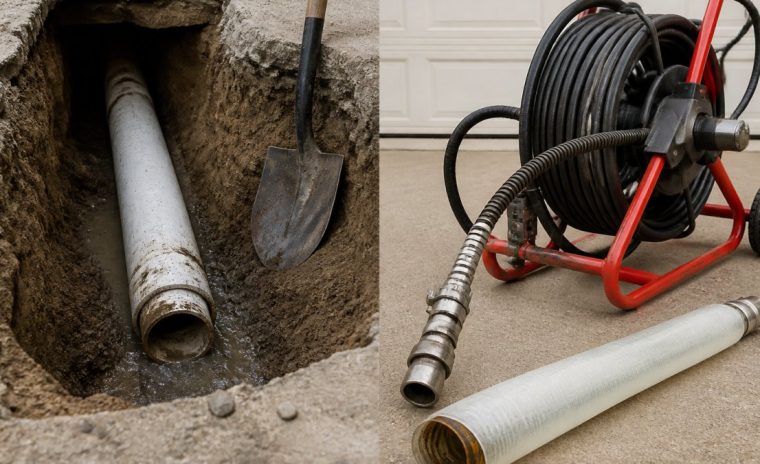
Table of Contents
- Trenchless Sewer Repair vs Traditional Digging: The Core Difference
- How Traditional Open-Cut Sewer Repair Works
- How Trenchless Sewer Repair Works: Pipe Lining and Pipe Bursting
- Pipe Lining vs. Pipe Bursting: Which Trenchless Method Fits Your Pipe?
- Trenchless Sewer Repair Cost vs Open-Cut Pricing
- Sewer Camera Inspection: The Diagnostic Step That Decides the Method
- Sewer Line Replacement Under Concrete Slab: What Each Method Means for Your Home
- Repair Time, Permits, and Project Logistics
- Frequently Asked Questions
Last Updated: October 20, 2026
Trenchless Sewer Repair vs Traditional Digging: The Core Difference
Trenchless sewer repair vs traditional digging comes down to one question: does the yard get destroyed? Traditional open-cut repair digs a continuous trench to expose the pipe. Trenchless sewer repair works through small access points and leaves the surface mostly intact.
Here is the short version:
| Factor | Trenchless | Traditional Open-Cut |
|---|---|---|
| Excavation | Two small access pits | Continuous trench |
| Yard and hardscape | Mostly untouched | Full restoration needed |
| Typical timeline | Often days | Often weeks |
| Best for | Cracks, root intrusion, worn pipe | Collapsed or misaligned pipe |
Below, we break down both methods, the real cost drivers, and how to tell which one fits your line.
How Traditional Open-Cut Sewer Repair Works
Open-cut is the dig-and-replace method. A crew excavates a trench along the sewer line, removes the failed section, and installs new pipe. It is blunt, proven, and sometimes unavoidable.
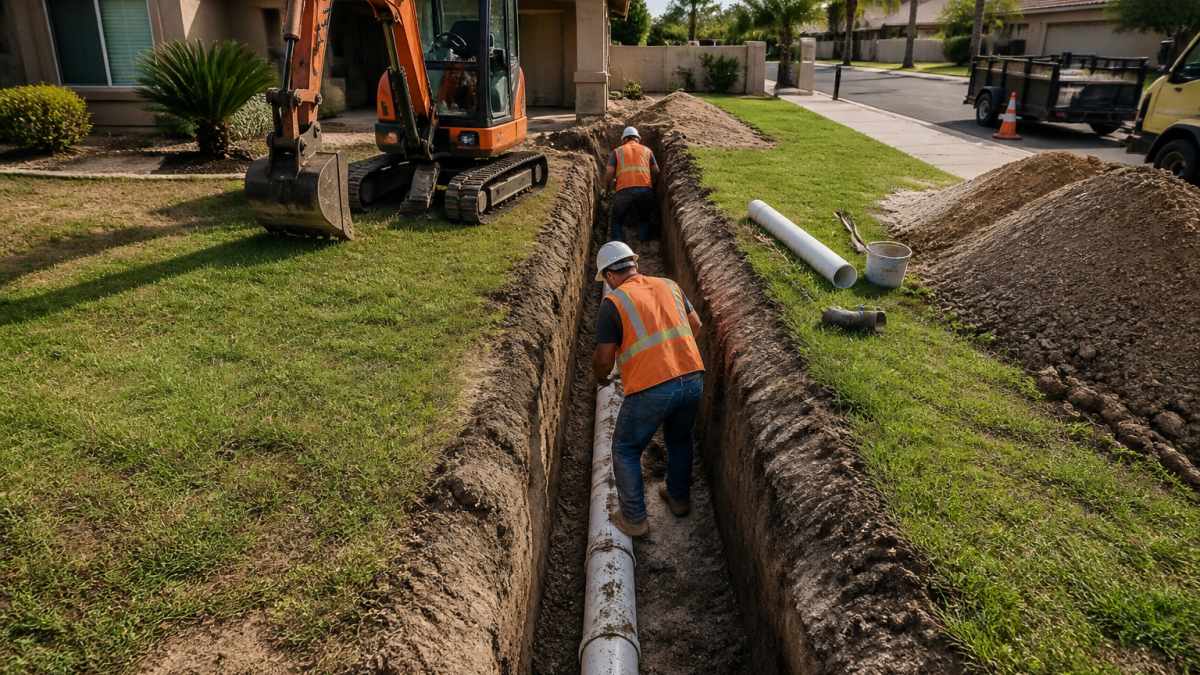
The Dig-and-Replace Process, Step by Step
- Locate the line and mark utilities
- Cut and remove the surface (soil, concrete, or pavers)
- Excavate down to the sewer pipe
- Remove the damaged section
- Set new pipe at the correct slope
- Backfill, compact, and restore the surface
Restoration is the hidden cost here. Landscaping damage and hardscape restoration often outpace the pipe work itself.
When Open-Cut Excavation Is the Only Option
Some conditions rule out trenchless work:
- Collapsed pipe that cannot hold a liner
- Severe misalignment or a broken line with offset joints
- Heavy root intrusion that has deformed the pipe
A common mistake is assuming trenchless always wins. It does not. A collapsed line needs excavation.
How Trenchless Sewer Repair Works: Pipe Lining and Pipe Bursting
Trenchless methods fall into two families: rehabilitate the existing pipe, or replace it in place. Both use small entry and exit points instead of a full trench.
Cured-in-Place Pipe (CIPP) Lining Explained
CIPP lining pulls a resin-saturated liner into the old pipe, inflates it, and cures it in place. The epoxy liner bonds to the pipe wall and forms a new, smooth interior. It seals cracks, stops leaks, and blocks root intrusion. Service life is long when the host pipe is structurally sound.
Pipe Bursting and Replacement Pipe
Pipe bursting pulls a bursting head through the old line, fracturing it outward while dragging new replacement pipe behind. The flow capacity stays the same or improves. This method suits pipes that are too far gone for lining but still follow a stable path.
Pipe Lining vs. Pipe Bursting: Which Trenchless Method Fits Your Pipe?
Pipe lining vs. pipe bursting is a condition question, not a preference. Lining keeps the existing pipe diameter and works when the pipe is cracked but intact. Bursting replaces the pipe entirely and works when the old line is badly deteriorated.
Pro Tip
If your line has a bellied section or a sharp offset, ask about bursting rather than lining. A liner follows the old shape, so it inherits the problem.
If your line has a bellied section or a sharp offset, ask about bursting rather than lining. A liner follows the old shape, so it inherits the problem.
Trenchless Sewer Repair Cost vs Open-Cut Pricing
Trenchless sewer repair cost often runs lower overall, but not because the pipe work itself is cheaper. The savings come from what you do not pay for. Broad percentage claims like “30-50% less” circulate widely, but they vary by region, line length, depth, soil, and surface type, so treat any single percentage as a rough starting point rather than a quote.
An Itemized Total-Cost Comparison
The only reliable way to compare the two methods is to price the same job line by line. Ask every contractor for a quote that separates these categories:
| Cost Category | Trenchless (CIPP or Bursting) | Traditional Open-Cut |
|---|---|---|
| Camera inspection and locating | Usually required; often credited toward the job | Usually required; often credited toward the job |
| Permits and utility marking | Typically required; scope varies by jurisdiction | Typically required; scope varies by jurisdiction |
| Access excavation (pits vs. trench) | Two small pits at entry and exit | Continuous trench along the line |
| Pipe repair or replacement labor | Comparable to open-cut for the pipe itself | Comparable to trenchless for the pipe itself |
| Materials (liner, resin, or new pipe) | Liner and resin costs scale with diameter and length | New pipe and fittings scale with diameter and length |
| Backfill and compaction | Minimal | Full trench backfill and compaction |
| Landscaping restoration | Usually none or spot repair | Sod, plants, irrigation, and soil replacement |
| Hardscape restoration | Usually none | Concrete, pavers, driveway, or patio replacement |
| Cleanup and waste hauling | Less spoil to haul | Significant spoil and debris hauling |
| Warranty and follow-up | Varies by installer and method | Varies by installer and method |
The pattern most practitioners see: the pipe-work line items land close to each other, and the gap opens in the restoration rows. On a job with mature landscaping, a driveway, or a finished patio over the line, those restoration rows can dominate the total. On a bare-soil side yard with easy access, the gap shrinks.
Why the Savings Number Moves So Much
Three variables drive most of the difference:
- Surface over the line. Concrete, pavers, and established landscaping raise open-cut restoration costs far more than they raise trenchless costs.
- Depth and length. Deeper and longer runs mean more excavation, more spoil, and more backfill on the open-cut side.
- Access. If the line runs under a slab, a finished basement, or a structure, open-cut may require interior work that trenchless avoids.
Watch Out
Be skeptical of any quote given over the phone before a camera inspection. A method quoted without seeing the pipe often changes mid-job, and the change order lands on you. Ask for the inspection findings in writing and a quote that separates pipe work from restoration.
Be skeptical of any quote given over the phone before a camera inspection. A method quoted without seeing the pipe often changes mid-job, and the change order lands on you. Ask for the inspection findings in writing and a quote that separates pipe work from restoration.
Questions to Ask Before You Compare Bids
- Does the quote separate pipe work from restoration?
- Is the camera inspection included, and will I receive the footage?
- Are permits and utility locating included or billed separately?
Request a written estimate after the camera inspection rather than trusting a phone number. The itemized quote is the only apples-to-apples comparison you can make.
Claim Your Free Estimate Today →
Sewer Camera Inspection: The Diagnostic Step That Decides the Method
A sewer camera inspection is a video survey of the inside of the line. It is the single most important step in choosing a repair method. Cracks, leaks, root intrusion, corrosion, collapsed pipe, and misaligned pipe all show up on camera.
Watch Out
Skipping the camera to save time is the most expensive shortcut in this trade. Crews that quote a method without seeing the pipe often switch mid-job, and the change order lands on you.
Skipping the camera to save time is the most expensive shortcut in this trade. Crews that quote a method without seeing the pipe often switch mid-job, and the change order lands on you.
Use this decision guide:
- Cracks or leaks, pipe still round → CIPP lining
- Root intrusion at joints → lining after cutting roots
- Collapsed or crushed section → open-cut or pipe bursting
Sewer Line Replacement Under Concrete Slab: What Each Method Means for Your Home
Sewer line replacement under concrete slab is where trenchless earns its reputation. Open-cut means breaking out the slab, digging, then repouring. Trenchless work enters from outside the slab, so the floor stays intact.
For slab-on-grade homes, this difference matters. Slab restoration adds cost and downtime. Trenchless methods keep the living space usable while the line is repaired.
Key Takeaway
For slab foundations, ask specifically whether the crew can work without cutting the slab. If the answer is yes, the project gets simpler and cheaper.
For slab foundations, ask specifically whether the crew can work without cutting the slab. If the answer is yes, the project gets simpler and cheaper.
Repair Time, Permits, and Project Logistics
Repair time favors trenchless in most cases, but permits, utility locating, and logistics still shape the schedule. Most jurisdictions require a permit for sewer repair or replacement, and the scope of that permit differs between a spot repair, a full lining job, and a pipe-bursting replacement. Confirm the requirement before work starts.
Permits, Utility Locating, and Code Compliance
A practical sequence most crews follow:
- Call 811 before you dig. The national call-before-you-dig service arranges marking of public utilities. It is free to the homeowner and required in most states before excavation. Private lines on your property, irrigation, gas to a grill, landscape lighting, usually are not marked by 811 and must be located separately.
- Confirm the permit scope. Ask whether the permit covers inspection, repair, and restoration, or only the pipe work. Some jurisdictions require a separate inspection sign-off before backfill.
- Check property boundaries. If the line crosses a property line or an easement, the neighbor or easement holder may need to be notified, and access agreements may be required.
- Verify code compliance for the method. Not every jurisdiction has adopted provisions for CIPP lining or pipe bursting. Ask the contractor whether the local authority having jurisdiction has approved the method for your pipe material and diameter.
- Schedule the inspection. Many jurisdictions require the pipe to be inspected before it is covered, whether by backfill or by a cured liner.
Pro Tip
Ask who handles the permit and the 811 locate. A crew that manages both saves you a week of phone calls and avoids the most common scheduling delay.
Ask who handles the permit and the 811 locate. A crew that manages both saves you a week of phone calls and avoids the most common scheduling delay.
What to Expect Before, During, and After
Before the crew arrives:
- Clear access to the cleanout and to the area where pits or a trench will be dug.
- Move vehicles out of the driveway and off the street in front of the work area.
- Keep pets indoors and away from open pits and equipment.
During the work:
- Expect noise from excavation equipment, a jetter, or a bursting head, depending on the method.
- Sewer service is usually out for hours, not days, on a trenchless job; open-cut jobs can run longer.
- Ask the crew to photograph and video the pipe before and after so you have a record.
After the work:
- Walk the site with the crew before they leave and note any restoration items in writing.
- Confirm the warranty terms and get them in the contract, not just in conversation.
- Keep the camera footage and inspection report; they are useful if you sell the home or file a warranty claim.
Key Takeaway
Most scheduling delays come from permits and utility locating, not from the repair itself. Start those two steps first, and the rest of the project moves faster.
Most scheduling delays come from permits and utility locating, not from the repair itself. Start those two steps first, and the rest of the project moves faster.
Timeline Expectations
Trenchless jobs often finish in days because there is no trench to backfill and no surface to restore. Open-cut jobs often run weeks once restoration is counted. The repair itself may take a similar number of crew hours; the difference is in the excavation and restoration phases that trenchless avoids.
Frequently Asked Questions
How does trenchless sewer repair compare with traditional digging?
Trenchless sewer repair works through small access points, typically a few feet wide, instead of a continuous trench along the entire line. Traditional digging removes the full run of soil and landscaping to expose the old pipe. Trenchless methods like pipe lining and pipe bursting usually finish faster, cause less property disruption, and avoid hardscape restoration costs, but they require a pipe in suitable condition. Collapsed, severely misaligned, or bellied lines often still need open-cut excavation, which is why a sewer camera inspection comes first.
How long does trenchless sewer repair take?
Most residential trenchless jobs finish in one to three days, depending on the length of the line, the method used, and site conditions. Cured-in-place pipe lining is often a single-day project for a typical house-to-street run. Pipe bursting takes longer because the old pipe is fractured and a new replacement pipe is pulled through. Open-cut excavation usually runs several days to a week or more once you count excavation, pipe installation, backfill, and restoration of landscaping or concrete.
Is pipe lining cheaper than replacement?
Pipe lining often costs less than a full open-cut replacement because it skips excavation and restoration. The savings come from labor and property repair, not from cheaper materials. That said, lining only works when the existing pipe can hold the liner, so a corroded or collapsed line may rule it out. A sewer camera inspection confirms whether lining, pipe bursting, or open-cut replacement is the right call for your line before any price comparison means anything.
How do you replace a sewer line under a concrete slab?
Under a slab, trenchless methods usually win. Pipe lining installs a resin-saturated liner through existing access points, so the slab stays intact. Pipe bursting pulls a new pipe through the old one’s path from small entry and exit pits, which may require only limited concrete removal at those points. Full open-cut replacement means breaking out the slab, digging the trench, replacing the pipe, and pouring new concrete, which adds restoration cost and time to the project.
A failing sewer line is stressful, and the method choice drives both cost and disruption. Acclaimed Drain And Plumbing Solutions, LLC starts with a camera inspection, then explains your options in plain terms. We offer trenchless sewer liner technology, free estimates, financing for eligible projects, and 24/7 emergency service. Get started with Acclaimed Drain And Plumbing Solutions, LLC and restore steady flow across your main line.