Get straightforward recommendations and dependable workmanship for your plumbing needs. We provide free estimates, and we offer financing for eligible projects, so you can plan repairs or upgrades with clear options and organized scheduling.
Tankless vs Tank Water Heater Cost: Upfront Price Comparison
The tankless vs tank water heater cost gap shows up before a single drop of hot water runs. Tankless units cost more upfront because of the equipment plus the venting, gas line, and electrical work they demand. Storage tanks cost less to buy and install, which is why many homeowners default to them.
At Acclaimed Drain & Plumbing Solutions, LLC, we install and service both types across Tucson and Southern Arizona, and the honest answer is that the cheaper unit on the invoice is not always the cheaper unit over ten years.
The trade-off: tankless costs more on day one and less every month after; tanks are the reverse. Which wins depends on how long you stay, your water hardness, and your hot water usage.
Unit Prices and Installation Labor
A standard 50-gallon gas tank water heater and a tankless unit have different upfront costs. The tankless figure assumes your home already has the venting, gas capacity, and electrical service the unit needs. Most homes don’t.
Installation labor is where they diverge most. A like-for-like tank swap is a few hours: drain, disconnect, reconnect, test. A tankless conversion is a small construction project, most of a day, sometimes two if gas lines need rerouting.
Tank replacement: simple disconnect and reconnect, minimal labor
Tankless conversion: new mounting, venting, gas or electrical work, longer labor window
Retrofitting an older home: often the largest single line item
The Line-Item Breakdown Most Quotes Hide
Sticker price and installed price are two different numbers. Here is where the gap between them actually comes from, and roughly what each line item adds to a tankless conversion in a typical retrofit:
Line Item
Tank Replacement
Tankless Conversion
Unit + basic labor
$1,200-$2,500
$1,200-$3,500
Stainless steel venting (gas)
Reuses existing flue
Often $400-$1,200 new
Gas line upsizing
Rarely needed
$300-$1,500 if capacity is short
Electrical panel work (electric)
Rarely needed
$500-$2,500 for new circuits or panel upgrade
Permit and inspection
Often $50-$200
Often $100-$400
Condensate management (condensing units)
N/A
$100-$300 for drain routing
Those ranges are wide on purpose. A home with a short vent run, a 200-amp panel, and a 3/4-inch gas line lands at the bottom of every range; a 1960s ranch with a half-inch gas stub, a 100-amp panel, and a long horizontal vent run stacks every line item at the top. That’s how two neighbors with the same unit get quotes differing by two thousand dollars.
Venting. Gas tankless units need stainless steel venting meeting specific clearance requirements, and a standard metal flue usually can’t be reused. Condensing models add a second wrinkle: acidic condensate that must be neutralized and routed to a drain, another line item a tank never generates.
Gas line capacity. A typical tank draws around 40,000 BTU; many tankless models need 150,000 to 200,000 BTU. If your gas line can’t carry that volume, it must be upsized, a licensed job that often requires a separate gas permit on top of the water heater permit.
Electrical upgrades. Electric tankless models pull heavy amperage. A whole-home unit can require 120 to 150 amps of dedicated capacity, more than many older 100-amp panels can spare, and panel work adds both cost and permitting time.
Permits and inspection. Most jurisdictions require a permit for water heater replacement, and tankless conversions often trigger extra inspection steps for gas, venting, and electrical work. Cutting corners creates real liability, a failed inspection can force a redo at your expense.
Watch Out Skipping a load calculation before buying a tankless unit is the most common and most expensive mistake we see. A unit that’s undersized for your household’s flow rate will run constantly, short-cycle, and never deliver the hot water you paid for. Size it wrong and you’ve spent tankless money for tank-level performance.
Ask any contractor for a written, itemized quote that lists venting, gas line, electrical, permit, and condensate line items separately. A single lump-sum number hides the retrofit costs that decide whether tankless makes financial sense for your home. If a quote doesn’t break these out, that’s a red flag.
Tankless Water Heater Installation Cost: What Drives the Price Up
Tankless water heater installation cost is driven by four factors: unit capacity, existing infrastructure, fuel type, and local permitting. Two homes on the same street can get quotes differing by more than a thousand dollars for the same unit.
Capacity is the first lever. A whole-home system for a family of five costs more than a point-of-use unit for one bathroom. Flow rate, measured in gallons per minute (GPM), determines which unit you need, running a shower and dishwasher at once requires a higher GPM rating than a single-occupancy home.
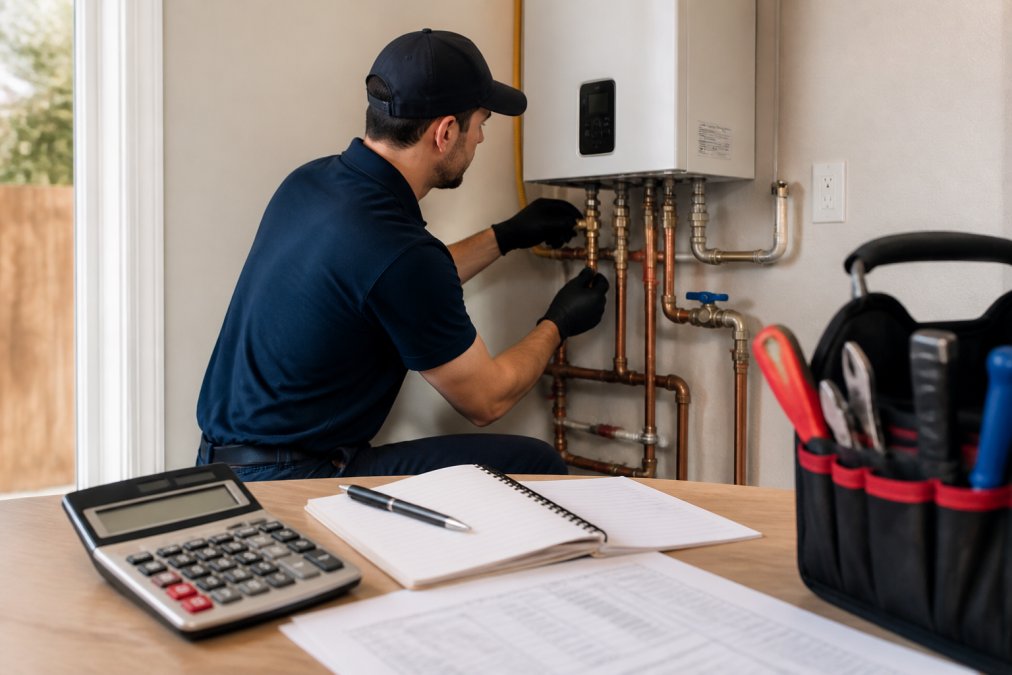
A licensed plumber in uniform installing a wall-mounted tankless water heater in a residential utility room, with copper piping and tools visible, natural lighting
Infrastructure is the second lever, and usually the biggest. Retrofitting a tank-built home means new venting, a possible gas line upgrade, and sometimes a new electrical circuit. Tankless-ready homes skip most of that.
Fuel type is the third. Gas units need venting and gas capacity; electric units need panel capacity but no venting. Neither is universally cheaper. It depends on what your home already has.
Permitting and inspection round out the cost. Most jurisdictions require a permit for water heater replacement, and tankless conversions often trigger additional inspection steps.
Ask your plumber for a load calculation in writing before you sign anything. It takes fifteen minutes and it’s the single best protection against buying the wrong unit. If a quote doesn’t include one, that’s a red flag.
Energy Efficiency and Annual Utility Savings
Tankless units are more efficient because of standby heat loss. A storage tank keeps 40 to 50 gallons hot around the clock, whether you’re using it or not, energy spent heating water nobody is using. Tankless heats on demand, with no standing reservoir to keep warm.
Tankless efficiency gains can be significant over traditional tanks, meaningful annual utility savings, though the exact dollar amount depends on your utility rates, household size, and hot water use.
The efficiency advantage shrinks with low hot water demand: less standby loss to eliminate means smaller savings. High-demand households capture the most benefit.
Factor
Tankless
Tank
Standby heat loss
None
Continuous
Efficiency vs. tank
24-34% better
Baseline
Best for high demand
Yes
Limited by tank size
Best for low demand
Smaller savings
Adequate
Tankless Water Heater Lifespan vs Tank Longevity
Tankless water heater lifespan generally runs longer than tank longevity, and the gap matters for total cost of ownership. A well-maintained tankless unit can outlast a storage tank by years, spreading its higher upfront cost across a longer service life.
The catch is maintenance. A tankless unit that never gets descaled will fail early, sometimes before a tank would. In hard water areas, calcium deposits build up inside the heat exchanger and choke the flow, so efficiency drops and the unit works harder for less output.
Storage tanks have their own failure mode: the tank corrodes from the inside out. Once the steel gives way, there’s no repair, only replacement.
So the lifespan comparison isn’t tankless versus tank in the abstract. It’s maintained tankless versus maintained tank. Skip maintenance on either and the numbers change fast.
Water Heater Maintenance Requirements: Costs and Schedules
Water heater maintenance requirements differ sharply between the two types, and this is where the long-term cost picture gets honest.
Tank maintenance is minimal: an annual flush to clear sediment and a check of the anode rod. Many homeowners skip it entirely and replace the tank when it fails.
Tankless maintenance is more involved and more frequent. Manufacturers recommend descaling once a year, sometimes more in hard water areas. Descaling pumps a mild acid solution through the unit to dissolve calcium deposits from the heat exchanger, not difficult, but skipping it is the fastest way to shorten a tankless unit’s life.
A tankless descaling kit makes the job DIY-friendly, but many prefer professional service as part of a maintenance schedule. Water hardness is the deciding variable: soft water means less frequent descaling, hard water means more.
Key Takeaway Budget for annual descaling if you go tankless. It’s the single maintenance task that determines whether your unit lasts twelve years or six. The upfront savings from skipping it vanish the moment the heat exchanger fails.
Total Cost of Ownership and Regional Efficiency Factors
Total cost of ownership is where the tankless vs tank water heater cost question actually gets answered. Upfront price is one input; utility savings, maintenance, lifespan, and repair costs are the others. Here is the full 10-year math.
A 10-Year TCO Framework You Can Run Yourself
Take the installed price, add ten years of utility costs, ten years of maintenance, and one mid-life repair allowance, then subtract any residual value or warranty credit. That cost-per-year figure is far more useful than the sticker price.
Here is a representative 10-year comparison for a household of four in a moderate climate, using national-average utility rates. Your numbers will shift with local rates, water hardness, and usage, but the structure holds:
Cost Category
Tankless (gas, condensing)
Tank (50-gal gas)
Installed cost
$3,200
$1,800
Annual utility cost
$180
$260
10-yr utility total
$1,800
$2,600
Annual maintenance
$150 (descaling)
$50 (flush)
10-yr maintenance total
$1,500
$500
Mid-life repair allowance
$400
$300
Replacement within 10 yrs
No (15-20 yr life)
Yes (8-12 yr life)
Second unit installed
$0
$1,800
10-year total
$6,900
$7,000
The two columns land within a few hundred dollars of each other, the honest takeaway most cost guides avoid. Tankless wins on utility savings and avoids a mid-decade replacement, but higher install and maintenance costs claw most of that back. Break-even typically falls between year six and year nine, which is why length of stay is the single most important variable.
Change one input and the answer flips. Drop maintenance to every other year and tankless pulls ahead by $750. Move to a hard-water region and descaling frequency doubles, pushing tankless behind. Stay only five years and the tank wins outright, the tankless unit never lives long enough to pay back its premium.
Regional Climate and Groundwater Temperature
This is the factor almost every cost comparison ignores, and it changes the efficiency math more than most homeowners expect.
Tankless units are rated by “temperature rise”, the degrees they must add to incoming water to hit your setpoint. In the Sun Belt, incoming water sits at 65-75°F year-round, so a unit only needs a 50-60°F rise to reach 120°F. In northern states, winter groundwater drops to 40-45°F, requiring an 80°F rise. That larger rise cuts effective flow rate by 30-40%, so a household needing a 9 GPM unit in a warm climate may need 12 GPM up north.
The efficiency gap also narrows in warm climates. A storage tank loses standby heat to surrounding air, and in a hot garage that loss is smaller; in a cold basement the tank bleeds heat faster, widening tankless’s advantage. The result: tankless pays back faster in cold climates and slower in warm ones, the opposite of what most homeowners assume.
Water Hardness: The Hidden Multiplier
Water hardness matters as much as climate. Hard water accelerates scale buildup in tankless heat exchangers, raising maintenance costs and shortening lifespan; soft water removes that penalty. Two homes with identical units and usage can have very different ten-year costs based on water chemistry alone. A $20 test kit or a call to your utility will tell you your water hardness, worth knowing before you choose a system, not after.
Environmental Impact
Tankless units use less energy over their life, lowering operational carbon footprint. But manufacturing footprint, the stainless steel and electronics, and eventual disposal are part of the picture too. Neither type is a clear environmental winner in every case: tankless reduces operational emissions, tank reduces embodied emissions per dollar spent, and the crossover depends on your local grid and how long the unit lasts.
If you’re weighing this decision for your own home, the honest answer is that a written load calculation and a real quote beat any generic comparison. Acclaimed Drain & Plumbing Solutions, LLC provides free estimates and can walk you through both options with your actual water hardness, gas capacity, and household demand in hand.
Is it worth replacing a tank water heater with a tankless model?
It depends on your hot water use and how long you plan to stay in the home. Tankless units cost more upfront, but they generally last longer than tanks and cut standby heat loss. If you use a lot of hot water or want to free up floor space, the long-term savings can justify the switch. For low-demand households, a tank may be the more practical choice.
What is the downside of a tankless water heater?
The main downsides are higher upfront costs, complex installation, and ongoing maintenance. Tankless units often require venting upgrades, larger gas lines, or electrical panel work that adds to the installation bill. They also need annual descaling to prevent calcium deposits, especially in hard water areas. Finally, flow rate limits mean you may not run multiple showers and appliances at once with a smaller unit.
Is a tankless water heater cheaper to operate monthly than a tank model?
Yes, in most cases. Tankless water heaters are generally more efficient than storage tanks because they heat water on demand and avoid standby heat loss. That efficiency usually shows up as lower monthly utility bills. However, the exact savings depend on your local energy rates, household hot water use, and the unit’s energy factor. In regions with high gas or electric rates, the monthly gap widens.
How do installation costs differ between tank and tankless systems?
Tank water heater installation is generally simpler and cheaper. Tankless installation may require new venting, upgraded gas lines, or electrical work, which can increase the cost. Retrofitting an older home can push tankless costs higher if the existing infrastructure doesn’t meet current plumbing code compliance.
Do tankless water heaters require more maintenance than tank models?
Yes. Tankless units need annual descaling to remove calcium deposits and maintain flow rate. Tank water heaters need periodic flushing and anode rod checks, but less frequently. In hard water areas, tankless maintenance is non-negotiable to protect the heat exchanger and extend tankless water heater lifespan.