
Claim Your Free Estimate Today

Table of Contents
- What Causes Hard Water Buildup in Southern Arizona Homes
- Tools and Cleaning Solutions You Need Before You Start
- How to Remove Hard Water From Faucets, Fixtures, and Showerheads
- How to Remove Hard Water Stains From Glass Shower Doors
- Best Hard Water Stain Remover for Your Shower: What Actually Works
- Troubleshooting: When Your First Attempt Fails to Remove Hard Water
- How to Prevent Hard Water Buildup Long-Term
- Frequently Asked Questions
Last Updated: August 10, 2026
Southern Arizona has some of the hardest water in the United States. If you live in Tucson or the surrounding area, you already know what that means: white crusty buildup on your faucets, cloudy glass shower doors, and fixtures that look dirty no matter how often you clean them. The culprit is calcium carbonate and magnesium, minerals that dissolve into groundwater as it passes through limestone and chalk deposits. This guide from Acclaimed Drain And Plumbing Solutions, LLC breaks down the best way to remove hard water stains, ranked by surface type and severity.
Hard water buildup is not just cosmetic. Left unchecked, mineral deposits restrict flow through faucet aerators, degrade fixture finishes, and accelerate wear on appliances. According to the U.S. Geological Survey water hardness data, much of the American Southwest, including Tucson, consistently measures among the hardest water regions in the country, with hardness levels that make regular descaling a genuine maintenance requirement.
What Causes Hard Water Buildup in Southern Arizona Homes
Hard water buildup is the residue left behind when water evaporates and the dissolved minerals it carried do not. Every drop of water that sits on a surface deposits a microscopic layer of calcium carbonate and magnesium. Over time, those layers accumulate into the white, chalky calcification most homeowners recognize immediately.
Southern Arizona’s geology makes this worse than most regions. The water supply draws heavily from groundwater sources that travel through calcium-rich rock formations, arriving at your tap with a high mineral load. The dry climate compounds the problem: water evaporates quickly, leaving mineral deposits behind faster than in humid regions.
Key Takeaway
Hard water is a chemistry problem, not a cleanliness problem. The most effective solutions work by lowering pH to dissolve calcium carbonate, not by scrubbing harder.
Hard water is a chemistry problem, not a cleanliness problem. The most effective solutions work by lowering pH to dissolve calcium carbonate, not by scrubbing harder.
Tools and Cleaning Solutions You Need Before You Start
Getting organized before you start saves time and prevents surface damage. The wrong cleaner on the wrong surface is one of the most common mistakes people make when tackling mineral deposits.
| Method | Best For | Dwell Time | Surface Risk |
|---|---|---|---|
| White vinegar | Light to moderate buildup | 30 min – 2 hours | Low on most surfaces |
| Citric acid solution | Moderate buildup, appliances | 15-30 min | Low to moderate |
| Baking soda paste | Gentle scrubbing, grout | 10-15 min | Very low |
| Commercial descaler (CLR) | Heavy calcification | 2-5 min | Moderate, follow instructions |
| Isopropyl alcohol | Glass finishing, light spots | Immediate | Very low |
Basic supplies you need:
- White vinegar (standard 5% acidity)
- Citric acid powder (available at grocery stores and online)
- Baking soda
- Microfiber cloths and non-abrasive scrubbing pads
- Old toothbrush for aerators and grout lines
- Rubber gloves
- Spray bottle
- Plastic bags and rubber bands (for soaking fixtures in place)
- Commercial descaler for severe cases
Natural Options: White Vinegar, Baking Soda, and Citric Acid
White vinegar is the most accessible natural descaler available. Its mild acidity dissolves calcium carbonate without damaging most common bathroom and kitchen surfaces. For light to moderate hard water spots, undiluted white vinegar left to dwell for 30 minutes to two hours removes most surface residue without scrubbing.
Citric acid works on the same principle but at higher concentration. Mix one to two tablespoons of citric acid powder per cup of warm water for a solution that outperforms vinegar on moderate buildup, particularly inside appliances like coffee makers and kettles.
Baking soda is mildly alkaline and works as a gentle abrasive. Mix it into a paste with water or vinegar and use it to scrub surfaces where you need mild mechanical action without scratching. Dwell time matters more than scrubbing force, letting an acidic solution sit on mineral deposits for the full recommended time does most of the work.
Chemical-Based Descalers: When to Use Them Safely
Commercial descalers like CLR (Calcium, Lime & Rust Remover) contain stronger acids that dissolve heavy calcification faster than natural alternatives. Use them when natural methods have failed after two or three attempts, or when buildup is thick enough to restrict water flow. Always read the label before applying to any surface. Chemical descalers are not appropriate for natural stone, marble, or unsealed grout, the acid will etch and damage those surfaces permanently.
Watch Out
Never mix commercial descalers with bleach-based cleaners. The combination produces chlorine gas, which is hazardous in enclosed spaces like bathrooms. Ventilate the area, wear rubber gloves, and rinse surfaces thoroughly after the recommended dwell time.
Never mix commercial descalers with bleach-based cleaners. The combination produces chlorine gas, which is hazardous in enclosed spaces like bathrooms. Ventilate the area, wear rubber gloves, and rinse surfaces thoroughly after the recommended dwell time.
How to Remove Hard Water From Faucets, Fixtures, and Showerheads
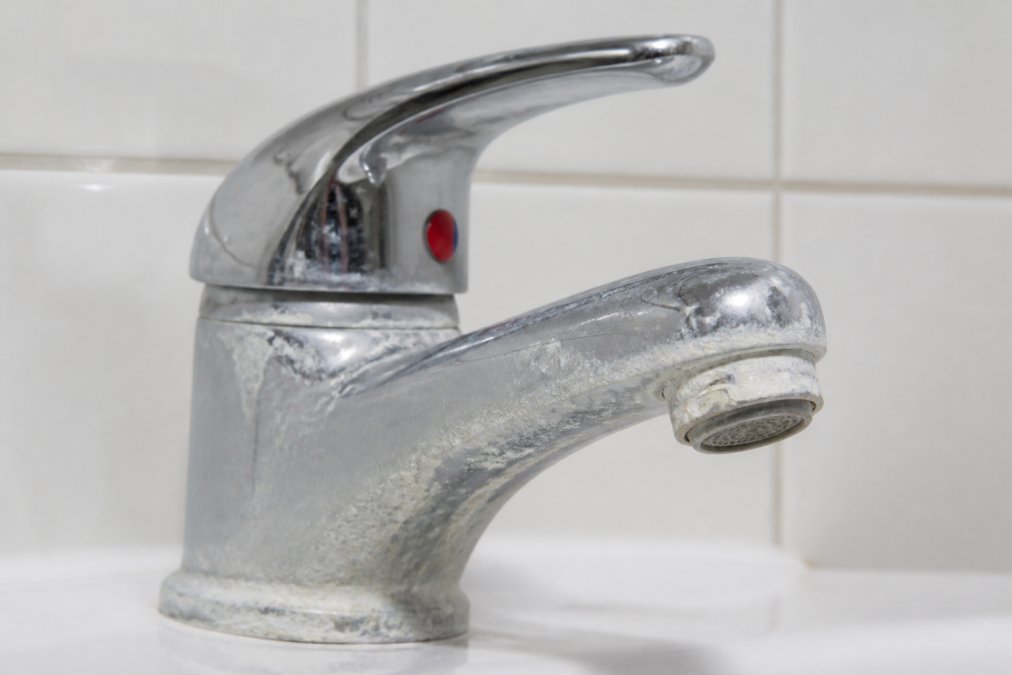
Faucets and showerheads are where hard water damage is most visible and most disruptive. Mineral deposits inside a showerhead restrict flow and reduce water pressure. Most faucet and showerhead buildup responds well to soaking.
Step-by-Step: Soaking and Scrubbing Faucet Aerators
The faucet aerator, the small mesh screen at the tip of your faucet, collects mineral deposits faster than almost any other fixture component.
- Unscrew the aerator by hand or with a wrench wrapped in a cloth to avoid scratching the finish.
- Place the aerator in a small bowl filled with undiluted white vinegar or a citric acid solution.
- Let it soak for at least one hour. For heavy calcification, soak overnight.
- Use an old toothbrush to scrub away loosened deposits.
- Rinse thoroughly under running water.
- Reinstall the aerator. If flow is still restricted, the aerator screen may need replacement.
For a showerhead, fill a plastic bag with white vinegar, secure it around the showerhead with a rubber band so the head is fully submerged, and leave it for two to four hours. Remove the bag, run hot water for 30 seconds to flush loosened deposits, and wipe the exterior with a microfiber cloth.
Surface Compatibility: What You Can and Cannot Use on Chrome, Brass, and Stone
Chrome: Handles white vinegar and citric acid solutions well. Avoid leaving acidic solutions on chrome for more than two hours. Never use abrasive scrubbing pads on chrome.
Brass (unlacquered): Responds well to diluted vinegar (one part vinegar to one part water). Undiluted acids can strip the patina.
Brushed nickel: Use only mild solutions, diluted vinegar at a 1:1 ratio with water. Avoid commercial descalers entirely.
Natural stone (marble, travertine, granite): Never use any acidic cleaner. Use only pH-neutral stone cleaners specifically formulated for these materials.
Ceramic and porcelain tile: Generally tolerates vinegar and commercial descalers well. Test in an inconspicuous area first if the tile has a decorative glaze.
How to Remove Hard Water Stains From Glass Shower Doors
Glass shower doors are frustrating because hard water spots bond to the glass surface and resist casual cleaning attempts.
Claim Your Free Estimate Today →
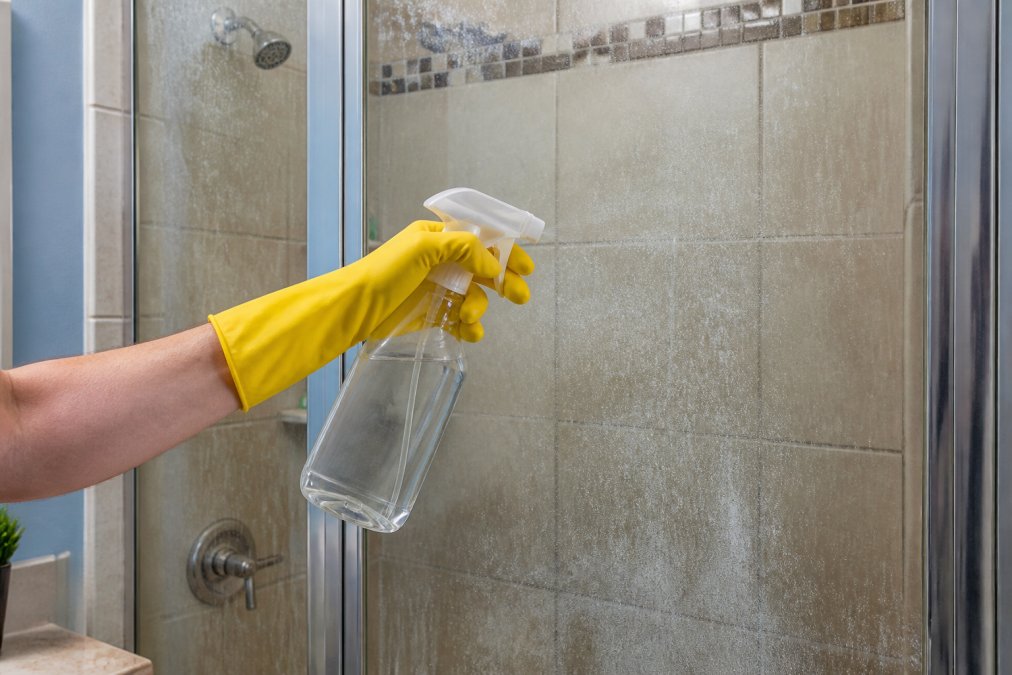
- Mix equal parts white vinegar and warm water in a spray bottle.
- Spray the entire glass surface generously and let it dwell for at least 15 minutes. For heavy mineral film, apply undiluted vinegar and extend dwell time to 30 minutes.
- Sprinkle a small amount of baking soda onto a damp non-abrasive scrubbing pad.
- Scrub in circular motions, working from top to bottom.
- Rinse thoroughly with warm water.
- Dry immediately with a clean microfiber cloth. Leaving water on glass after cleaning deposits new minerals immediately.
For stubborn hard water spots that survive this treatment, isopropyl alcohol applied with a microfiber cloth removes the remaining surface residue and leaves glass clear. According to the American Cleaning Institute’s surface care guidelines, drying surfaces immediately after cleaning is one of the most effective ways to prevent mineral deposits from reforming after removal.
Pro Tip
A squeegee kept inside the shower and used after every use is the single most effective tool for preventing glass shower door buildup. It takes 15 seconds and eliminates the need for aggressive cleaning sessions.
A squeegee kept inside the shower and used after every use is the single most effective tool for preventing glass shower door buildup. It takes 15 seconds and eliminates the need for aggressive cleaning sessions.
Best Hard Water Stain Remover for Your Shower: What Actually Works
The best hard water stain remover for your shower depends on the severity of the buildup and the surfaces involved. For light to moderate buildup on tile, glass, and chrome fixtures, white vinegar remains the most practical starting point. For moderate to heavy buildup, a citric acid solution outperforms vinegar. For severe calcification, a commercial descaler like CLR is the right tool. Always verify surface compatibility before applying.
The most common mistake when choosing a hard water stain remover is selecting the strongest available product by default. On natural stone, brushed nickel, or lacquered brass, the strongest product causes the most damage. Match the product to the surface first, then adjust for severity.
Troubleshooting: When Your First Attempt Fails to Remove Hard Water
Most first attempts fail for one of three reasons: insufficient dwell time, the wrong product for the surface, or buildup that has calcified too deeply for surface-level treatment.
Dwell time was too short. If you applied vinegar and wiped it off after five minutes, the acid did not have time to dissolve the calcium carbonate. Reapply and extend dwell time to the maximum recommended for that surface.
The surface has multiple layers of buildup. Heavy calcification built up over months or years may require two or three treatment cycles. Each cycle removes a layer.
The wrong cleaner was used. If you used a neutral or alkaline cleaner, it will not dissolve mineral deposits regardless of dwell time. Descaling requires an acidic solution.
When to call a professional: If buildup inside pipes is restricting water pressure throughout the home, or if fixtures show signs of corrosion beneath the mineral layer, surface cleaning will not solve the underlying problem. Acclaimed Drain And Plumbing Solutions, LLC offers professional water treatment consultations and whole-home filtration assessments for Tucson homeowners dealing with chronic hard water issues.
How to Prevent Hard Water Buildup Long-Term
Removing hard water stains is reactive. The more useful question is how to prevent hard water buildup from forming in the first place, because in Southern Arizona, it will always come back if the source water is not treated.
Daily Habits That Stop Mineral Deposits From Forming
- Dry surfaces after use. Wipe down faucets, shower glass, and tile with a dry cloth or squeegee after each use. Water that does not evaporate on the surface cannot leave mineral deposits behind.
- Run the exhaust fan. Reducing bathroom humidity slows evaporation on surfaces, which reduces deposit formation.
- Rinse fixtures after cleaning. Cleaning product residue can attract mineral buildup. Always rinse surfaces thoroughly and dry them.
- Check aerators every three months. Catching light buildup early means a quick vinegar soak rather than an hour of scrubbing.
Water Softeners and Whole-Home Treatment: Cost vs. Benefit
The most permanent solution to hard water is treating the water before it reaches your fixtures. Water softeners use ion exchange technology to replace calcium and magnesium ions with sodium ions, delivering softened water throughout the home.
Salt-based water softeners are the most effective whole-home option for severe hard water. Salt-free water conditioners are an alternative for households on sodium-restricted diets; they do not remove hardness minerals but alter their structure to reduce scale adhesion.
Hard water accelerates wear on water heaters, dishwashers, washing machines, and plumbing fixtures. The Water Quality Association’s consumer resources on water hardness documents the relationship between water hardness and appliance longevity, which is useful context for evaluating whether a softener investment makes financial sense for your household.
Key Takeaway
In Southern Arizona, a water softener or whole-home conditioner is not a luxury upgrade. Given local water hardness levels, it is a practical maintenance investment that reduces cleaning time, extends appliance life, and protects plumbing fixtures.
In Southern Arizona, a water softener or whole-home conditioner is not a luxury upgrade. Given local water hardness levels, it is a practical maintenance investment that reduces cleaning time, extends appliance life, and protects plumbing fixtures.
Salt-based softeners discharge brine during regeneration cycles, which has prompted some municipalities to regulate or restrict their use. EPA guidance on water softener discharge and environmental impact provides current federal guidance on this topic. Salt-free conditioners and electronic water conditioners avoid this issue entirely.
Chronic hard water is one of the most common and most overlooked plumbing challenges for Tucson homeowners. Surface cleaning handles the visible symptoms, but persistent buildup, restricted water pressure, and accelerated fixture wear often point to a systemic water quality issue that surface treatments cannot address. Acclaimed Drain And Plumbing Solutions, LLC offers professional water treatment and filtration services, whole-home plumbing assessments, and fixture maintenance to help Southern Arizona homeowners get consistent water quality and reliable performance from their plumbing systems. Contact the team to claim your free estimate today.
Frequently Asked Questions
Does vinegar actually remove hard water stains?
Yes, white vinegar removes hard water stains effectively on most surfaces. Its acetic acid dissolves calcium carbonate and magnesium deposits on contact. For light buildup, spray undiluted white vinegar, let it sit for 15 to 30 minutes, then scrub and rinse. For heavier limescale, soak a cloth in vinegar and press it against the surface for an hour or longer. Avoid using vinegar on natural stone like marble or travertine, as the acidic solution can etch the surface and cause permanent damage.
What is the strongest calcium remover for tough hard water buildup?
For severe calcification, a commercial descaler containing hydrochloric or phosphoric acid outperforms vinegar and citric acid. Products formulated specifically to dissolve calcium carbonate and mineral deposits work fastest on grout, toilet bowls, and tile. Always check surface compatibility before applying, wear gloves and eye protection, and ensure the area is ventilated. For buildup inside pipes or water heaters caused by extreme water hardness, a whole-home water softener addresses the root cause rather than just the visible surface residue.
How do you remove hard water stains from glass shower doors without scratching them?
Use a non-abrasive approach: apply undiluted white vinegar or a citric acid solution to the glass, let it dwell for 20 to 30 minutes, then wipe with a soft microfiber cloth. For stubborn hard water spots, make a paste of baking soda and white vinegar, apply gently, and rinse thoroughly. Never use steel wool or harsh abrasive pads on glass, as they cause permanent scratches. After cleaning, squeegee the glass after every shower to prevent new mineral deposits from forming.
How do you prevent hard water buildup from coming back?
Prevention requires both daily habits and a longer-term system change. Wiping down fixtures and glass after each use stops mineral deposits from drying onto surfaces. Installing a whole-home water softener eliminates the calcium and magnesium in your water supply before it reaches your fixtures, which is the most effective long-term fix for homes with high water hardness. Salt-free water conditioners are a lower-maintenance alternative that reduce scale formation without removing minerals entirely. Regular descaling of faucet aerators and showerheads every one to three months also keeps buildup manageable.
