
Claim Your Free Estimate Today
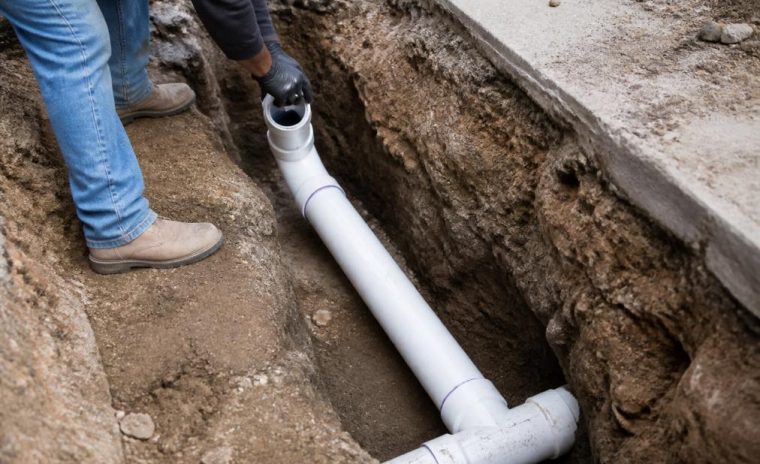
Table of Contents
- What Drives the Cost of Main Sewer Line Repair
- Trenchless Sewer Repair vs Excavation: Which Costs Less?
- Sewer Camera Inspection Cost and Why It Matters
- Repair vs Full Line Replacement: Breaking Down the Numbers
- Homeowners Insurance Sewer Line Coverage: What’s Covered
- Warning Signs Your Main Sewer Lateral Needs Immediate Attention
- Permits, Inspection Fees, and Financing Options
- Conclusion: Getting an Accurate Repair Estimate
- Frequently Asked Questions
Last Updated: September 11, 2026
What Drives the Cost of Main Sewer Line Repair
The cost of main sewer line repair depends on three variables: pipe material, line depth, and how much ground must be opened. Two identical-looking backups can produce wildly different quotes because the failure itself differs.
At Acclaimed Drain And Plumbing Solutions, LLC, we diagnose the line before we price the fix. Here are the factors that move a sewer line repair estimate.
Pipe Material: Clay, Cast Iron, and PVC
Pipe material sets the baseline. Clay pipes, common in older neighborhoods, crack and shift as soil moves, and root intrusion at the joints is routine. Cast iron corrodes from the inside out until the walls thin and the pipe collapses. PVC resists both, so a PVC failure usually points to ground shifting or a physical break.
Material also determines the repair method. A short section of damaged PVC can be cut out in hours, while a run of cracked clay pipes may need longer replacement because patching one joint leaves the next weak point exposed.
Labor Rates and Excavation Costs
Labor and excavation typically account for the largest share of any sewer line repair bill. Excavation is priced by line depth, how much soil must be removed, and what sits above it, such as a driveway, patio, or mature landscaping.
Two points most estimates bury in fine print:
- Linear foot pricing applies to the pipe run, but access work is often billed separately.
- Restoration, meaning backfill and surface repair, may or may not be included.
Always ask for a written breakdown separating pipe, labor, and excavation before comparing bids.
Trenchless Sewer Repair vs Excavation: Which Costs Less?
Trenchless sewer repair usually costs less overall than traditional excavation because it avoids large-scale digging, though the upfront pipe cost can run higher. Trenching opens the full length of the line, while trenchless methods work through small access pits at each end.
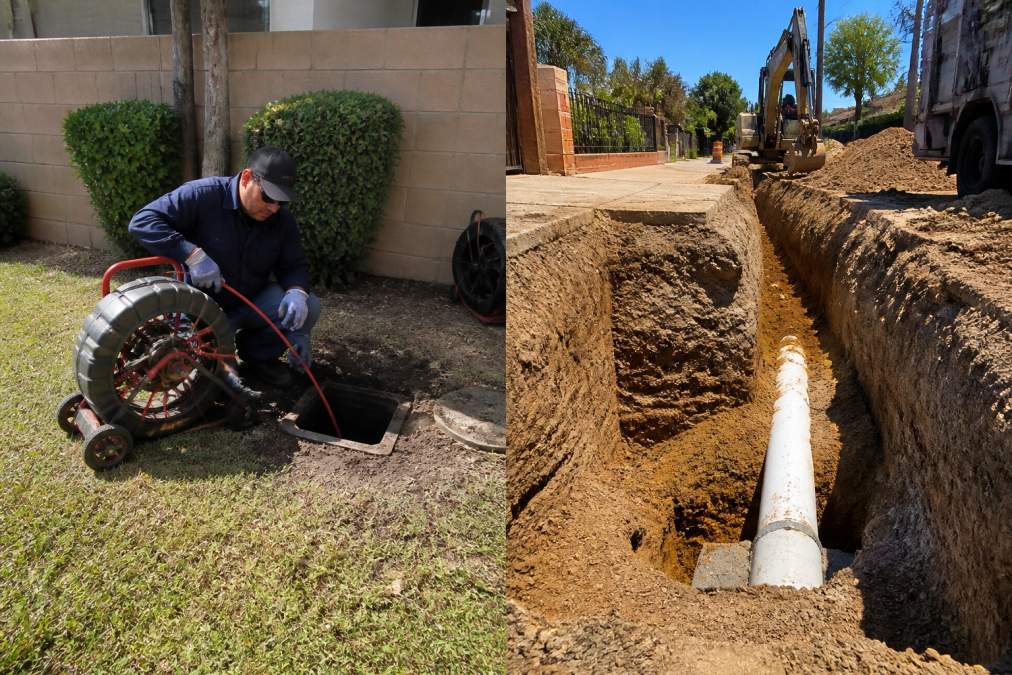
For a line under a finished driveway or mature tree, trenchless often wins on total cost once you factor in replacing what excavation destroys. For a shallow line in open yard, trenching can be simpler and cheaper.
| Method | Ground Disturbance | Best For | Main Drawback |
|---|---|---|---|
| Traditional excavation | Full trench along line | Shallow lines, open yard | Landscape and hardscape damage |
| Pipe bursting | Small access pits | Replacing old pipe with new | Requires suitable pipe material |
| Cured-in-place pipe (CIPP) | Small access pits | Structural lining of existing pipe | Not ideal for collapsed lines |
Pipe Bursting and Cured-in-Place Pipe (CIPP)
Pipe bursting pulls a new pipe through the old one while fracturing the original outward, replacing the line without a full trench. Cured-in-place pipe (CIPP) inserts a resin liner cured against the inside wall, restoring structural integrity without removing the old pipe. Both require a sewer camera inspection first, and neither works if the line has fully collapsed or the existing pipe is the wrong material.
Sewer Camera Inspection Cost and Why It Matters
A sewer camera inspection is the single most important diagnostic step before any repair quote. A camera pushed through the main sewer lateral shows exactly where the problem sits, a root intrusion, a crack, a bellied section, or a full sewer line collapse. Without that footage, you are guessing, and guessing leads to spot repairs that fail within months. Many contractors credit or waive the inspection when you proceed, so ask for the video and photos, not just a verbal summary.
Pro Tip
Request a copy of the camera footage and the locator marks on the surface. That footage is your proof of what was found, and it protects you if a second opinion contradicts the first quote.
Request a copy of the camera footage and the locator marks on the surface. That footage is your proof of what was found, and it protects you if a second opinion contradicts the first quote.
Repair vs Full Line Replacement: Breaking Down the Numbers
Repair makes sense when damage is isolated. Full line replacement makes sense when the pipe has failed in multiple places, the material is at the end of its service life, or spot repairs keep recurring. The decision is a cost-per-year calculation, not a cost-per-job calculation.
Cost by Project Scope
Exact pricing depends on depth, access, pipe material, and local labor rates, but the ranges below reflect what most homeowners see. Treat them as planning figures, not quotes.
| Scope | Typical Cost Range | What It Covers |
|---|---|---|
| Spot repair (single crack or joint) | $250 – $1,500 | Cutting out and replacing a short section of pipe |
| Sectional replacement (10-25 ft) | $1,500 – $5,000 | Replacing a longer damaged run, often with trenchless methods |
| Full line replacement (standard 50-75 ft) | $4,000 – $15,000 | Entire lateral from house to municipal connection |
| Full replacement with heavy access work | $10,000 – $25,000+ | Line under driveway, slab, or mature landscaping |
| Trenchless lining (CIPP) | $4,000 – $12,000 | Structural liner installed inside existing pipe |
| Pipe bursting | $5,000 – $15,000 | New pipe pulled through old, old pipe fractured outward |
These ranges assume a standard single-family home with a lateral under 100 feet. Longer runs, deeper lines, and urban access constraints push toward the top of each range or beyond.
The Cost-Per-Year Math
A spot repair that costs $800 and lasts two years works out to $400 per year. A full replacement that costs $8,000 and lasts 50 years works out to $160 per year. That comparison matters more than the sticker price of the first invoice. Watch for the third-repair trap: the first spot repair lasts a few years, the second a year, the third a few months, by then you have spent a meaningful fraction of replacement cost and still own a failing line.
Decision Framework
Use these questions to decide:
- How many repairs has this line had in the last five years? Two or more points toward replacement.
- What is the pipe material and age? Cast iron past 50 years and clay past 60 years are near end of life (the EPA). PVC in good condition usually justifies repair.
- How extensive is the damage on camera? One crack is a repair. Multiple cracks, offset joints, or a belly along the run is a replacement.
- Is the line undersized or out of code? If the existing pipe is 4-inch clay and current code requires 6-inch PVC, a repair locks in a non-compliant line.
- What is the access situation? If the line runs under a finished driveway, doing the job once with trenchless replacement often beats repairing now and excavating later.
- How long do you plan to stay? If you are selling within two years, a documented repair with warranty may be the better financial move. If this is your forever home, replacement usually wins.
What a Good Estimate Includes
Whether you choose repair or replacement, the written estimate should itemize:
Pro Tip
Ask the contractor to quote both a repair and a replacement on the same visit. Comparing the two side by side, with the same scope assumptions, is the fastest way to see whether the repair is genuinely the better value or just the smaller invoice.
Ask the contractor to quote both a repair and a replacement on the same visit. Comparing the two side by side, with the same scope assumptions, is the fastest way to see whether the repair is genuinely the better value or just the smaller invoice.
Warranty and Follow-Up
Repair warranties are typically shorter, often one to two years on the repaired section only. Full replacement warranties commonly run 10 years or more on pipe and workmanship, though they usually exclude damage from roots, ground movement, or misuse. Get the warranty in writing and confirm whether it transfers if you sell.
Key Takeaway
Do not compare repair and replacement on price alone. Compare them on cost per year of service, on warranty length, and on how many more times you are likely to see the same crew in your yard. The cheapest job is the one you only pay for once.
Do not compare repair and replacement on price alone. Compare them on cost per year of service, on warranty length, and on how many more times you are likely to see the same crew in your yard. The cheapest job is the one you only pay for once.
Homeowners Insurance Sewer Line Coverage: What’s Covered
Homeowners insurance sewer line coverage is one of the most misunderstood parts of a sewer repair bill. A standard HO-3 policy almost never covers the buried main sewer lateral itself. It may cover resulting damage inside the home, ruined flooring, drywall, or personal property, if the loss traces to a covered peril such as a sudden accidental discharge. Gradual deterioration, root intrusion, and wear-and-tear are excluded across the board (naic.org). That matters because the two most common sewer failures, tree roots and aging pipe, are exactly the causes standard policies exclude.
Service Line Endorsements and Riders
Homeowners actually get the lateral covered by adding a service line endorsement (also called a service line rider or buried utility line coverage). These add-ons typically cover the pipe itself, excavation, and sometimes access restoration. Verify before you file:
- Coverage limit: Endorsements usually cap at a fixed amount per occurrence. Confirm whether that cap is per line or per policy term.
- Access and restoration: Some pay to dig and backfill but not to replace a driveway, patio, or mature landscaping. Others include it. Read the access provision.
- Peril trigger: Most still require a covered cause, sudden breakage, not gradual corrosion. A camera inspection showing decades of root intrusion can be used to deny the claim.
- Deductible: Service line endorsements often carry their own deductible, separate from the main policy deductible.
Home Warranty Plans
A home warranty is not insurance. It is a service contract, usually sold at closing or renewed annually, covering repair or replacement of systems and appliances that fail from normal wear and tear. Many plans include sewer and drain line coverage as an optional add-on. The trade-offs:
- Home warranties typically require you to use their network contractor, not the plumber of your choice.
- They often cap payouts per item and exclude pre-existing conditions or code violations.
- They may cover a spot repair but deny full line replacement, leaving you with a patched line that fails again.
If you have both a home warranty and a service line endorsement, read both before calling either. Filing with the wrong one first can complicate the second claim.
How to File a Sewer Line Claim
- Stop the damage. Turn off water if sewage is backing up and keep people away from contaminated areas.
- Document everything. Photograph the backup, affected rooms, and damaged belongings. Keep receipts for emergency cleanup or hotel stays if the home is temporarily uninhabitable.
- Get a camera inspection and written diagnosis. A licensed plumber’s report with footage and locator marks is the strongest evidence you can hand an adjuster.
- Notify your insurer promptly. Late reporting is a common denial reason.
- Get the scope in writing. The estimate should separate pipe, labor, excavation, access restoration, and permits.
- Keep a claim log. Note every call, adjuster name, date, and what was said for a potential appeal.
Watch Out
Do not authorize permanent repairs before the adjuster inspects, unless the work is emergency stabilization to prevent further damage. Insurers can reduce or deny reimbursement for work performed before they had a chance to document the loss.
Do not authorize permanent repairs before the adjuster inspects, unless the work is emergency stabilization to prevent further damage. Insurers can reduce or deny reimbursement for work performed before they had a chance to document the loss.
When a Claim Is Denied
Denials are common because the cause is usually excluded. If you believe the denial is wrong, request the specific policy language cited, ask for a re-inspection with your plumber present, and appeal in writing with the camera footage attached. For stalled disputes, most states have a free department of insurance complaint process.
Financing Options When Insurance Won’t Pay
Because most homeowners end up paying out of pocket, financing matters. Common routes:
Key Takeaway
Before you assume you are covered, pull your policy and look for the words “service line,” “buried utility line,” or “sewer lateral.” If those words are not there, you are almost certainly paying out of pocket, so get financing lined up before the crew arrives, not after.
Before you assume you are covered, pull your policy and look for the words “service line,” “buried utility line,” or “sewer lateral.” If those words are not there, you are almost certainly paying out of pocket, so get financing lined up before the crew arrives, not after.
Warning Signs Your Main Sewer Lateral Needs Immediate Attention
Several symptoms point to a failing main sewer lateral, and ignoring them usually raises the eventual cost. Watch for:
Backflow and sewage backup into the home are the clearest emergency signals. A backup that reaches living space is a health issue, not just a plumbing inconvenience, and it needs same-day attention.
Watch Out
Pouring chemical drain cleaner into a backed-up main line can worsen the problem (the CDC). If the blockage is a root mass or a collapsed section, the chemicals sit against the pipe and accelerate corrosion without clearing the blockage.
Pouring chemical drain cleaner into a backed-up main line can worsen the problem (the CDC). If the blockage is a root mass or a collapsed section, the chemicals sit against the pipe and accelerate corrosion without clearing the blockage.
Permits, Inspection Fees, and Financing Options
Permit fees and inspection requirements vary by jurisdiction and are part of the real cost of main sewer line repair. Most municipalities require a permit for main line work, and the job must pass inspection before the trench is closed. Ask about payment plans before work begins, and confirm the estimate itemizes permit fees, inspection, backfill, and surface restoration rather than assuming them.
Key Takeaway
The lowest bid is not the cheapest job. Compare quotes on scope, not price alone: pipe material, method, permits, restoration, and warranty all belong in the comparison.
The lowest bid is not the cheapest job. Compare quotes on scope, not price alone: pipe material, method, permits, restoration, and warranty all belong in the comparison.
Conclusion: Getting an Accurate Repair Estimate
Sewer line problems rarely improve on their own, and delaying a diagnosis usually raises the final bill. Start with a camera inspection showing exactly what failed and where, then get a written estimate separating pipe, labor, excavation, and permits.
Acclaimed Drain And Plumbing Solutions, LLC provides free estimates, sewer camera inspections, trenchless sewer liner technology, and financing options for eligible projects, plus 24/7 emergency service when a backup cannot wait. Every job starts with a clear diagnosis and a straight explanation of your options.
Claim your free estimate today and get a written scope you can actually compare.
Frequently Asked Questions
How much should a main sewer line repair cost on average?
The cost of main sewer line repair depends on several factors: the length of pipe damaged, pipe material (clay, cast iron, or PVC), depth of the line, and whether the repair requires trenchless methods or traditional excavation. Spot repairs typically cost less than full line replacement. Labor rates, permit fees, and local conditions also affect the total. Request a free estimate from a licensed plumber who performs a sewer camera inspection first so you receive accurate pricing for your specific situation.
Will homeowners insurance cover sewer line repair?
Homeowners insurance sewer line coverage varies by policy. Most standard policies exclude damage from root intrusion, age, and general wear, but may cover sudden events like ground shifting or a sewer line collapse caused by a covered peril. Some insurers offer an endorsement for service line coverage. Review your policy or ask your agent whether sewer line repair is included. A home warranty may also cover portions of the repair depending on the plan.
Is trenchless sewer repair cheaper than excavation?
Trenchless sewer repair vs excavation costs differ based on site conditions. Trenchless methods like pipe bursting and cured-in-place pipe (CIPP) lining often cost more upfront per linear foot but reduce labor, restoration, and landscaping expenses. Excavation is typically less expensive for short spot repairs but can add significant cost when driveways, patios, or mature landscaping must be restored. A plumber can compare both options after a sewer camera inspection.
How often do residential sewer lines need to be replaced?
Sewer line lifespan depends on material. Clay pipes and cast iron pipes in older homes may last 50 to 100 years but are prone to root intrusion, cracking, and ground shifting damage. PVC piping typically lasts 50 years or more with fewer issues. Homes built before 1980 often need evaluation. Regular sewer camera inspections and hydro-jetting can extend service life and catch problems before a full line replacement is required.
EPA guidance on septic systems and sewer connections
CDC information on sewage backup cleanup and health risks
Consumer Financial Protection Bureau resources on home improvement financing
