
Claim Your Free Estimate Today
Table of Contents
- Understanding Peak Demand for a Family of 4
- Tankless Water Heater GPM Requirements Explained
- Temperature Rise and BTU Output for Your Climate
- Groundwater Temperature Map for Water Heater Sizing
- Gas vs. Electric Tankless: What Your Home Can Support
- Tankless Water Heater Installation Costs and Requirements
- Water Hardness and Descaling Maintenance
- Sizing a Tankless Water Heater for Your Family of 4
- Frequently Asked Questions
Last Updated: September 29, 2026
Understanding Peak Demand for a Family of 4
Determining what size tankless water heater for family of 4 starts with understanding that a family of four typically uses multiple fixtures simultaneously, showers, washing machines, and dishwashers running at once. Peak demand is the total water flow your home needs during its busiest moment, determined by this simultaneous usage.
Calculating simultaneous fixture usage
Start by listing every fixture that might run at once. A typical family of four might use:
- Master shower: 2.5 gallons per minute (GPM)
- Guest shower: 2.5 GPM
- Kitchen sink: 2.2 GPM
- Washing machine: 2.0 GPM
- Dishwasher: 1.5 GPM
Add up the fixtures you use together most often. If your family showers while someone runs the dishwasher, that’s 2.5 + 1.5 = 4.0 GPM minimum. Add a sink and your real peak demand reaches 5.0 to 6.5 GPM.
Most homeowners underestimate simultaneous usage, planning for ideal scenarios rather than realistic ones. Kids come home from school, guests visit, routines change. Plan for realistic peak demand.
Flow rate and showerhead requirements
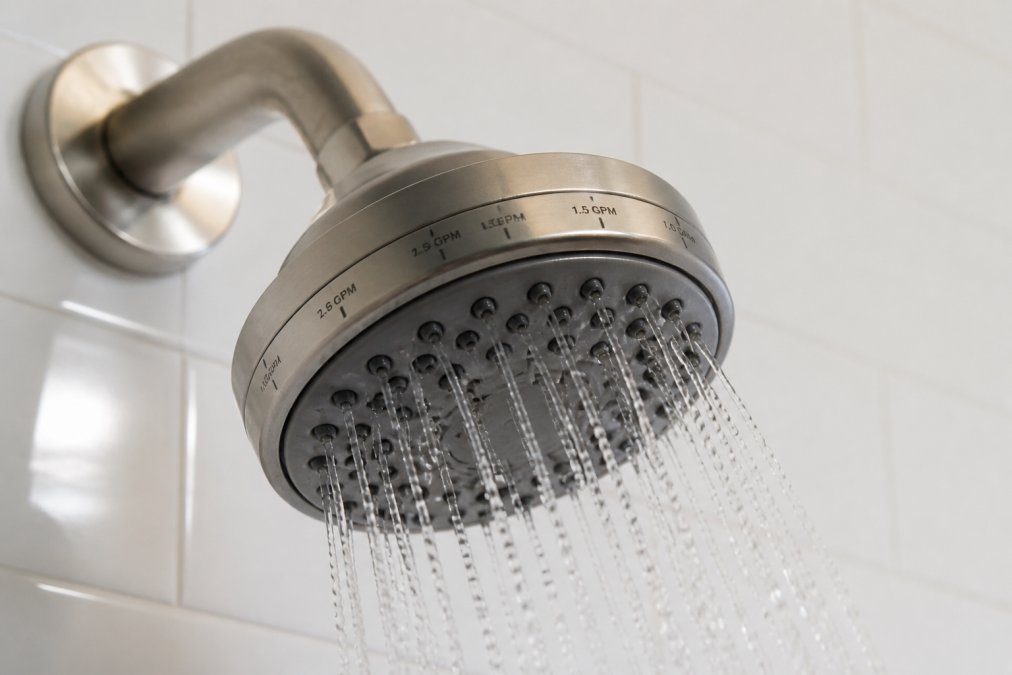
Modern showerheads flow at 2.0 to 2.5 GPM; older models at 3.0 to 5.0 GPM. Your showerhead flow rate directly impacts tankless sizing.
Low-flow showerheads reduce demand on your system. Retrofitting with 2.0 GPM heads can drop required tankless capacity by 10-15%, often cheaper than upgrading the heater.
Check your showerhead specifications. Look for the flow rate printed on the collar. If you have multiple showerheads, add them all together for your peak shower flow.
Tankless Water Heater GPM Requirements Explained
Your tankless water heater must deliver enough GPM to meet peak demand while raising water temperature. GPM and temperature rise work together, you can’t evaluate flow rate alone.
A 5.0 GPM unit might seem sufficient for a family of four, but cold groundwater requiring a large temperature rise causes it to struggle. Understanding this relationship prevents costly mistakes.
How to calculate the GPM you need
Start with your peak demand number, say 5.0 GPM at peak usage. Next, check your groundwater temperature. Cold groundwater requires more heating power. The unit must raise water from 40°F to 110°F (a 70-degree rise), while warm groundwater might need only a 30-degree rise.
When deciding what size tankless water heater for family of 4, most families need between 4.0 and 8.0 GPM; many installers recommend 6.0 GPM as a safe middle ground that handles simultaneous showers plus other fixtures.
Common sizing mistakes homeowners make
Mistake one: buying the smallest unit that meets minimum GPM. A 5.0 GPM unit technically handles 5.0 GPM demand but leaves zero margin, any slight increase in demand or temperature drop causes cold water complaints.
Mistake two: ignoring groundwater temperature. A unit rated for 5.0 GPM at 35°F inlet performs differently at 50°F. Check local groundwater data before finalizing your choice.
Mistake three: not accounting for future needs. If you plan to add a hot tub or outdoor shower, buy a larger unit now, upgrading later costs more.
Mistake four: assuming higher GPM always means better. A 10.0 GPM unit for a family needing 5.0 GPM costs more upfront and runs inefficiently.
Temperature Rise and BTU Output for Your Climate
Temperature rise is the difference between inlet water temperature and desired outlet temperature. BTU output is the heating power required to achieve that rise at peak flow rate.
A tankless unit with insufficient BTU output can’t maintain hot water during peak demand, resulting in lukewarm water. Understanding BTU requirements prevents this common complaint.
How groundwater temperature affects sizing
Cold climates have colder groundwater. Northern regions might see 35°F inlet temperature; southern regions 55°F. This 20-degree difference dramatically changes BTU needs.
A 5.0 GPM unit raising water 70 degrees requires roughly 350,000 BTU; raising water only 40 degrees requires 200,000 BTU. Your climate determines which unit works.
Check the groundwater temperature map for your region.
Determining BTU requirements for your region
Start with your peak GPM demand. Multiply by 8.33 (the weight of one gallon of water) and your desired temperature rise. Example: 5.0 GPM × 8.33 × 70°F rise = about 175,000 BTU per hour.
Groundwater Temperature Map for Water Heater Sizing
Northern states average 40-45°F groundwater; southern states 50-60°F. Coastal regions and high water table areas may vary depending on local geology.
Gas vs. Electric Tankless: What Your Home Can Support
Your home’s infrastructure determines whether you can install gas or electric. Understanding your options prevents expensive installation surprises.
Electrical service and amperage requirements
Electric tankless units demand significant amperage. A typical 240-volt unit for a family of four needs 40-50 amps. Some larger units need 60 amps or more.
Claim Your Free Estimate Today →
Gas line sizing and venting considerations
Gas units require properly sized gas lines. Undersized lines starve the unit of fuel, preventing adequate heating. Oversized lines waste space and cost more to install.
Tankless Water Heater Installation Costs and Requirements
Installation complexity varies widely. Some homes need minimal work. Others need extensive modifications. Understanding what affects your cost prevents budget surprises.
What affects your installation price
Several factors drive installation cost:
- Gas line sizing and installation
- Electrical upgrades (for electric units)
- Venting modifications
- Plumbing changes to connect the unit
- Permit and inspection fees
- Removal of old water heater
A straightforward replacement in a home with existing gas service costs moderately. A retrofit in an older home with no gas line and inadequate electrical service costs significantly more.
Integration with existing plumbing infrastructure
Your home’s plumbing layout affects installation. Tankless units work best when installed close to the point of use. Long runs of hot water pipe waste energy and delay hot water arrival.
Water Hardness and Descaling Maintenance
Hard water damages tankless units. Mineral buildup reduces efficiency and shortens lifespan. Understanding water hardness prevents expensive problems down the road.
Scale buildup and thermal efficiency loss
Hard water contains dissolved minerals (primarily calcium and magnesium) that accumulate on the heat exchanger inside your tankless unit. This buildup is called scale.
Maintenance schedule and real-world performance
Hard water (over 120 parts per million) requires annual descaling. This involves running a descaling solution through the unit. The process takes 1-2 hours and costs under $300.
Sizing a Tankless Water Heater for Your Family of 4
Now that you understand the factors, let’s apply them to your specific situation. This section walks through the actual sizing process.
Step-by-step sizing worksheet
Step 1: Calculate Peak Demand
List your fixtures and their GPM:
- Shower 1: ___ GPM
- Shower 2: ___ GPM
- Kitchen sink: ___ GPM
- Bathroom sink: ___ GPM
- Washing machine: ___ GPM
- Dishwasher: ___ GPM
- Other: ___ GPM
Add the fixtures that run simultaneously: Total Peak GPM = ___
Step 2: Find Groundwater Temperature
Step 3: Determine Temperature Rise
Desired hot water temperature (typically 110-120°F): ___°F
Step 4: Calculate Required BTU
Step 5: Choose Unit Type
Step 6: Account for Climate
| Factor | Your Value | Impact |
|---|---|---|
| Peak demand GPM | ___ | Determines minimum unit size |
| Groundwater temperature | ___ | Higher temp = lower BTU needs |
| Temperature rise needed | ___ | Larger rise = higher BTU needs |
| Hard water present | Yes/No | Affects maintenance frequency |
| Gas service available | Yes/No | Determines unit type options |
| Electrical service amps | ___ | May need upgrade for electric |
When to call a professional installer
Certain situations require professional assessment:
- Your home lacks gas service and electrical upgrade is needed
- You’re unsure about venting options
- Your water is very hard (over 200 PPM)
- You want to minimize installation disruption
- Your plumbing layout is complex
Professional installers handle sizing, permitting, and installation. They know local codes and utility requirements. They warranty their work.
Frequently Asked Questions
What size tankless water heater do I need for a family of 4?
Most families of 4 need a tankless water heater that delivers 6-8 GPM at a 35-45 degree temperature rise. This supports running two showers simultaneously or a shower and washing machine at the same time. Your exact size depends on groundwater temperature in your region, the flow rate of your fixtures, and whether you use gas or electric. A professional sizing assessment accounts for your climate zone and existing plumbing to avoid undersizing or overspending on excess capacity.
How does groundwater temperature affect tankless water heater sizing?
Groundwater temperature determines how much heating power (BTU or kilowatts) your unit must provide. Colder groundwater requires higher BTU output or larger electric capacity. For example, a region with 45-degree groundwater needs significantly more output than one with 55-degree groundwater to reach the same outlet temperature. This is why a tankless water heater sized for one climate zone may underperform in another. Checking your local groundwater temperature map is essential to accurate sizing and avoiding performance disappointment.
Can a tankless water heater handle two showers running at once?
Yes, if sized correctly. Two simultaneous showers typically require 5-6 GPM combined flow. A properly sized unit for a family of 4 should deliver 6-8 GPM at your desired temperature rise. However, many undersized units cannot maintain hot water temperature when multiple fixtures run together, which is why accurate peak demand calculation and proper sizing are critical. Real-world performance often differs from manufacturer specs, so professional assessment of your household’s simultaneous usage patterns is valuable.
What is the difference between GPM and temperature rise in tankless sizing?
GPM (gallons per minute) is the volume of hot water your unit can deliver. Temperature rise is how many degrees the unit heats incoming water. A unit rated 8 GPM at 35 degrees means it delivers 8 gallons per minute while raising water temperature by 35 degrees. Your groundwater temperature and desired outlet temperature determine the temperature rise you need. Both metrics must align with your peak demand to avoid running out of hot water during simultaneous showers or appliance use.
