
Claim Your Free Estimate Today

Table of Contents
- Tankless vs. Storage Tank: The Core Trade-Off for Small Homes
- Does a Tankless Water Heater Really Save Space and Energy?
- Tankless Water Heater Sizing Guide for Small Households
- Tankless Water Heater Installation Cost vs. Long-Term Value
- Tankless Water Heater Maintenance Requirements You Can’t Skip
- Retrofitting Older Small Homes: Gas Lines, Venting, and Electrical Load
- How to Decide If Tankless Is Worth It for Your Home
- Frequently Asked Questions
Last Updated: September 6, 2026
Whether a tankless water heater is worth it for small homes comes down to your hot water demand versus your home’s existing infrastructure. For a one- or two-person household, a tankless unit often delivers meaningful energy savings and frees up floor space, but the upfront investment and installation requirements can erase those gains if your plumbing and gas lines aren’t ready.
Tankless vs. Storage Tank: The Core Trade-Off for Small Homes
A tankless water heater heats water on demand rather than maintaining a 40- to 50-gallon reserve, eliminating standby heat loss entirely. That matters more in a small home, where a bulky storage tank can consume a surprising share of a tight utility closet or garage corner.
The trade-off is straightforward: you trade a lower purchase price and simple installation for a higher upfront cost and long-term efficiency. Storage tanks cost less to install and replace but typically last 10-15 years and waste energy keeping water hot around the clock. Tankless units carry a higher price tag and demand more from your gas line and venting, yet they last 20 years or more and only burn fuel when you turn on a tap.
Does a Tankless Water Heater Really Save Space and Energy?
Yes, on both counts, but the space savings are more dramatic than the energy savings in a small home. A typical storage tank stands about 60 inches tall and occupies roughly 20 square feet of floor space with clearance (homedepot.com). A wall-mounted tankless unit takes up a fraction of that footprint and frees the floor entirely.
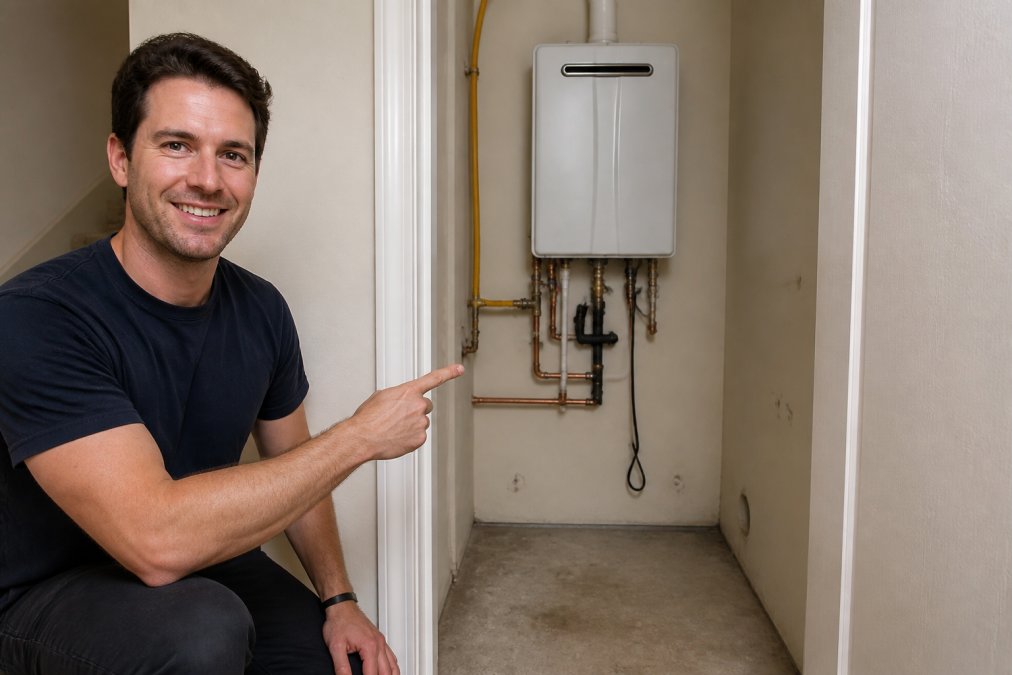
On energy, the gains come from eliminating standby heat loss, which is the energy a storage tank burns just to keep water warm between uses. The U.S. Department of Energy’s water heating guidance notes that tankless units are generally more efficient than storage tanks for households that use less than 41 gallons of hot water daily, which covers most small homes.
That said, the efficiency advantage narrows if you have long pipe runs from the heater to your fixtures, since waiting for hot water to travel wastes both water and energy.
Tankless Water Heater Sizing Guide for Small Households
Sizing a tankless water heater for a small home is a two-step calculation. First, determine your peak simultaneous flow demand in gallons per minute (GPM). Second, the step most homeowners skip, adjust that GPM rating for your local groundwater temperature. A unit that delivers 6.0 GPM in Florida may only deliver 3.5 GPM in Minnesota.
Step 1: Calculate Your Peak Simultaneous Demand
Add up the flow rates of the fixtures you realistically run at the same time. For a one- or two-person household, the realistic peak is almost always a shower plus a bathroom faucet.
| Fixture | Typical Flow Rate (GPM) |
|---|---|
| Showerhead (standard) | 2.5 GPM |
| Showerhead (low-flow) | 1.5-2.0 GPM |
| Bathroom faucet | 1.0-1.5 GPM |
| Kitchen sink | 1.5-2.0 GPM |
| Dishwasher | 1.5-2.0 GPM (if not cold-fill only) |
| Washing machine | 2.0-3.0 GPM (varies by cycle) |
For a couple where one person showers while the other runs the kitchen sink, peak demand is roughly 2.5 + 1.5 = 4.0 GPM. With a low-flow showerhead, that drops to about 3.0-3.5 GPM. Write down your own realistic peak, this is your target flow rate.
Step 2: Adjust for Groundwater Temperature (The Missing Step)
Every tankless unit’s GPM rating is based on a specific temperature rise, typically 77°F. The U.S. Department of Energy publishes average groundwater temperature maps, and the variation across the country is dramatic.
- Southern states (e.g., Florida, Texas, Arizona): Groundwater averages 70°F-75°F year-round. A unit rated at 6.0 GPM at a 77°F rise will deliver close to its full rated output.
- Mid-Atlantic and Pacific Northwest: Groundwater averages 50°F-60°F. That same unit’s output drops to roughly 4.5-5.0 GPM.
- Upper Midwest and Northeast (e.g., Minnesota, Wisconsin, Maine): Groundwater can drop to 40°F-45°F in winter. The temperature rise needed to reach 120°F is 75°F-80°F, and the unit’s output falls to about 3.5-4.0 GPM.
The practical rule: For every 10°F drop in incoming water temperature below the unit’s rated baseline, expect roughly a 10-15% reduction in maximum GPM output. A unit rated at 6.0 GPM at a 77°F rise will only deliver about 4.0 GPM when your incoming water is 45°F.
Watch Out
If you live in a cold-climate state and size your unit based on the rated GPM without adjusting for groundwater temperature, you will undersize the heater. The result is a shower that runs hot for five minutes, then goes cold, exactly the failure mode tankless is supposed to eliminate.
If you live in a cold-climate state and size your unit based on the rated GPM without adjusting for groundwater temperature, you will undersize the heater. The result is a shower that runs hot for five minutes, then goes cold, exactly the failure mode tankless is supposed to eliminate.
Step 3: Consider the Point-of-Use Alternative for Small Homes
Small homes have a unique option most guides ignore: instead of one large whole-home unit, install two or three small point-of-use (POU) tankless units at the fixtures that need them most. A 2.0-3.0 GPM electric unit under the kitchen sink and a 4.0 GPM unit dedicated to the shower can cover a small household’s needs without the expense of a single high-capacity unit.
This approach has three advantages for small homes:
- No gas line upsizing. Small electric POU units draw 15-30 amps on a dedicated 120V or 240V circuit, which is far easier to add than upsizing a gas line.
- No long pipe runs. Because the unit sits at the point of use, you eliminate the wait time and wasted water that comes from a central unit feeding distant fixtures.
- Redundant reliability. If one unit fails, you still have hot water at the other fixtures, a luxury a single whole-home unit doesn’t offer.
The trade-off is that POU units have a hard ceiling on simultaneous demand, you can’t run the shower and kitchen sink off a single 2.0 GPM unit. But if your peak demand is genuinely one fixture at a time, a POU setup can cut equipment cost by 30-50% compared to a whole-home unit plus infrastructure upgrades.
A Sizing Worksheet for Your Home
To settle on a number: (1) list your realistic simultaneous fixtures and their GPM, and add them up for your target flow; (2) find your average winter groundwater temperature; (3) calculate the temperature rise needed: 120°F minus your groundwater temperature; (4) compare that to the unit’s rated rise (usually 77°F) and reduce the rated GPM proportionally if yours is higher; (5) if the adjusted GPM is below your target, size up or consider a POU configuration.
For most one- and two-person households in moderate climates, a whole-home unit rated at 5.0-6.0 GPM at a 77°F rise is sufficient. In cold climates, you’ll need a unit rated at 7.0-8.0 GPM to deliver the same real-world output, or accept a lower simultaneous-demand ceiling and stagger your hot water use.
Tankless Water Heater Installation Cost vs. Long-Term Value
The tankless water heater installation cost is the biggest hurdle for most small-home owners, and it’s rarely as simple as swapping one unit for another. The real question is whether the total cost of ownership (TCO) over the unit’s lifespan beats a storage tank for your specific utility rates and usage patterns.
Breaking Down the Real Installation Cost Line Items
A storage tank replacement is typically a same-day job: pull the old tank, drop in the new one, reconnect the same gas line, vent, and water lines. A tankless installation is different. Here are the line items that drive the cost difference:
| Line Item | Storage Tank Replacement | Tankless Installation | Why It Differs |
|---|---|---|---|
| Unit cost | $500-$1,200 | $1,200-$2,500 | Higher-grade heat exchanger and electronics |
| Gas line upsizing | Usually not needed | $300-$800 | Tankless units need 3/4-inch line vs. 1/2-inch for tanks |
| Venting modification | Reuse existing vent | $400-$1,000 | Tankless requires dedicated stainless steel venting; can’t share a chimney |
| Electrical (for igniter/controls) | Existing | $150-$400 | Tankless needs a 120V outlet nearby |
| Condensate drain (condensing units) | Not applicable | $100-$300 | Condensing units produce acidic condensate that must be drained |
| Labor | $400-$800 | $800-$1,500 | More complex mounting, gas work, and commissioning |
| Permit and inspection | $50-$150 | $100-$250 | Gas line modifications typically require a permit |
Total realistic range: A straightforward tankless replacement where your gas line and venting happen to be adequate runs roughly $2,500-$4,000 installed. If you need a gas line upsized and new venting routed through finished walls, that number climbs to $4,500-$6,500. For comparison, a storage tank replacement typically lands between $1,200 and $2,500 installed.
The Total Cost of Ownership (TCO) Framework
Upfront cost is only half the equation. To decide whether tankless is worth it, compare the 20-year TCO of both options:
Step 1: Estimate annual energy cost.
The U.S. Department of Energy estimates water heating accounts for roughly 18% of a typical home’s energy use (energy.gov). For a small home using about 30 gallons of hot water per day, that’s roughly 1,500-2,500 kWh per year for an electric storage tank, or 150-250 therms for a gas storage tank. A tankless unit’s efficiency advantage (typically 8-14% higher for gas units, up to 30% for electric units in low-usage homes) reduces that consumption proportionally.
Step 2: Multiply by your local utility rate.
- If you pay $0.15/kWh for electricity and your electric storage tank uses 2,000 kWh/year, that’s $300/year. An electric tankless unit using 25% less drops that to $225/year, a $75 annual savings.
- If you pay $1.20/therm for natural gas and your gas storage tank uses 200 therms/year, that’s $240/year. A condensing tankless unit using 12% less drops that to $211/year, a $29 annual savings.
Step 3: Add maintenance costs.
Claim Your Free Estimate Today →
Storage tanks require essentially no routine maintenance beyond an occasional anode rod check. Tankless units require annual descaling at $100-$200 per service visit, $2,000-$4,000 over 20 years, a cost many TCO comparisons omit.
Step 4: Account for lifespan and replacement.
A storage tank lasts 10-15 years; a tankless unit lasts 20+. Over a 20-year horizon, you’ll likely replace the storage tank once (another $1,500-$2,500).
A Worked Example: The Break-Even Calculation
For a small home with gas service: a storage tank at $1,800 installed, 12-year lifespan, $240/year energy, and $0/year maintenance costs $1,800 + (20 × $240) + one replacement at year 12 ($1,800) = $8,400 over 20 years. A tankless unit at $4,000 installed, 20-year lifespan, $211/year energy, and $150/year maintenance costs $4,000 + (20 × $211) + (20 × $150) = $11,220. The tankless unit costs $2,820 more over 20 years, even with its efficiency advantage. The math only flips in tankless’s favor if installation is at the low end ($2,500), energy savings are at the high end (14%+), and you perform descaling yourself (dropping maintenance to $30/year in materials).
Key Takeaway
The common claim that “tankless pays for itself in energy savings” only holds under specific conditions: low installation cost, high utility rates, and a long ownership horizon. For many small-home owners, the tankless premium is a lifestyle purchase (space savings, endless hot water) rather than a pure financial win. Run your own numbers with your utility rates before you commit.
The common claim that “tankless pays for itself in energy savings” only holds under specific conditions: low installation cost, high utility rates, and a long ownership horizon. For many small-home owners, the tankless premium is a lifestyle purchase (space savings, endless hot water) rather than a pure financial win. Run your own numbers with your utility rates before you commit.
When the Math Favors Tankless
The TCO flips in tankless’s favor when any of these conditions apply:
- Your utility rates are above the national average. In states like California, Hawaii, or New York where electricity and gas rates run 50-100% above the national average, the annual energy savings double or triple.
- You’re replacing an electric storage tank with a gas tankless unit. The fuel switch from electricity to natural gas can cut your water heating energy cost by 50-60%, producing annual savings of $150-$300.
- You’re in the home for 15+ years. The longer your horizon, the more the tankless unit’s 20-year lifespan and efficiency advantage compound.
- Your installation requires no gas line or venting upgrades. If you’re building new or your existing infrastructure happens to be adequate, the upfront premium shrinks to $1,000-$1,500, which the efficiency gains can recoup in 8-12 years.
The Bottom Line on Cost
For a small home, the tankless decision is rarely a clear financial win on paper. It’s a trade-off: you pay a premium upfront and in annual maintenance for space savings, endless hot water, and a longer lifespan. If those benefits matter and you’re staying long-term, the premium is defensible. If you’re purely optimizing for the lowest 20-year cost, a high-efficiency storage tank is often the more rational choice.
Tankless Water Heater Maintenance Requirements You Can’t Skip
A tankless water heater maintenance schedule is non-negotiable. Unlike storage tanks, which you can largely ignore until they fail, tankless units require periodic descaling to remove mineral buildup from the heat exchanger.
Hard water accelerates this process considerably. If your water supply has high mineral content, scale can coat the heat exchanger and reduce efficiency within a year or two. Annual descaling with a vinegar or citric acid solution is standard; homes with very hard water may need it every six months.
This maintenance is straightforward for a professional and doesn’t require draining a large tank. Many plumbing companies offer maintenance membership programs that bundle annual descaling with a full system inspection, the easiest way for a non-handy owner to keep the unit under warranty and at peak efficiency.
Pro Tip
If you have hard water, consider installing a [water softener or conditioner](/say-goodbye-to-hard-water-problems-with-the-sp3-combo-system/) upstream of your tankless unit. This single addition can dramatically extend the time between descaling sessions and protect the heat exchanger, which is the most expensive component to replace.
If you have hard water, consider installing a [water softener or conditioner](/say-goodbye-to-hard-water-problems-with-the-sp3-combo-system/) upstream of your tankless unit. This single addition can dramatically extend the time between descaling sessions and protect the heat exchanger, which is the most expensive component to replace.
Retrofitting Older Small Homes: Gas Lines, Venting, and Electrical Load
Retrofitting an older small home presents challenges new construction doesn’t face. The plumbing infrastructure in a home built before the 1990s often wasn’t designed with tankless water heaters in mind, and the upgrade path depends heavily on whether you’re going gas or electric.
For gas units, the two critical questions are gas line capacity and venting configuration. A standard storage tank typically requires a 1/2-inch gas line, while many tankless units need a 3/4-inch line for their higher BTU input. Running a new gas line through finished walls is invasive and costly. Venting is equally important: tankless exhaust must go through a dedicated system, and the route to the exterior may not align with your existing chimney or vent stack.
Electric tankless units avoid venting but introduce a different problem: electrical load. A whole-home electric unit can draw 60 to 120 amps, often exceeding an older home’s panel capacity. Upgrading the panel is a significant expense that can rival the cost of the heater itself.
This is where a professional assessment matters. A licensed plumber can perform a load calculation and inspect your existing gas line and venting before you commit. Skipping this step is how homeowners end up buying a unit they can’t install without thousands in unexpected upgrades.
How to Decide If Tankless Is Worth It for Your Home
If you’re still asking whether tankless is worth it for small homes, answer these three questions honestly:
First, how long do you plan to stay? If five years or less, the payback period probably won’t arrive before you sell. If a decade or more, the efficiency gains and longer lifespan start to make the math work.
Second, what does your peak hot water demand actually look like? If you live alone or with one other person and rarely run two hot water fixtures simultaneously, tankless will serve you well. If you have a family scheduling back-to-back showers every morning, you’ll need to size carefully, and the cost advantage erodes.
Third, is your home’s infrastructure ready? Older homes often need gas line upgrades, new venting, or electrical panel work, all adding to the installation cost. A professional inspection before you buy will tell you exactly what you’re facing.
For most small-home owners with modest demand and a long-term horizon, tankless is a solid investment. The space savings alone can transform a cramped utility area, and the 20-year lifespan means you’ll likely never buy another water heater.
Making the call on tankless requires accurate diagnostics and an honest assessment of your home’s plumbing infrastructure. That’s exactly what the team at Acclaimed Drain And Plumbing Solutions, LLC provides. We handle tankless water heater installation, repair, and preventative maintenance, and we’ll give you a straight answer about whether the upgrade makes sense for your home before we quote any work. Contact Acclaimed Drain and Plumbing Solutions to schedule an inspection and claim your free estimate today.
Frequently Asked Questions
Why do plumbers sometimes advise against tankless water heaters?
Plumbers often caution against tankless units when the home’s existing infrastructure isn’t ready. Older small homes may have undersized gas lines, insufficient electrical panels, or complex venting requirements. These retrofitting challenges can add significant cost to the installation. A professional should perform a load calculation to confirm your home can support the unit. If the infrastructure needs major upgrades, the total investment may outweigh the benefits for a small household.
Can a tankless water heater replace my 40-gallon storage tank?
Yes, in most cases a tankless unit can replace a 40-gallon tank. The key is selecting a model with the right flow rate for your home. A 40-gallon tank typically supports 2 to 3 simultaneous fixtures. A whole-home tankless unit with an adequate gallons per minute (GPM) rating can match that. However, you must also factor in your groundwater temperature and the unit’s venting requirements. A proper tankless water heater sizing guide helps ensure you don’t end up with weak water pressure.
How much maintenance does a tankless water heater actually need?
Tankless units require more regular maintenance than storage tanks. The primary task is descaling the heat exchanger once a year to remove mineral buildup, especially in areas with hard water. Many manufacturers void the warranty if you skip this step. You may need a plumber to perform the descaling service using a vinegar solution and a circulation pump. While this adds an annual service cost, the longer lifespan of a tankless unit often still makes the overall investment worthwhile.
What is the downside of a tankless water heater for a small house?
The main downsides are the higher upfront installation cost and the potential for infrastructure upgrades. While you save floor space, the unit still requires proper venting and either a gas line or electrical circuit. If you have a very small home with low hot water demand, a point-of-use tankless heater for one or two fixtures might be more practical than a whole-home unit. The payback period depends on your energy usage and local utility rates.
