
Claim Your Free Estimate Today

Table of Contents
- Why Is My Water Pressure Low in Commercial Buildings
- Pressure Boosting Systems and VFD Pumps
- Commercial Water Booster Pump Systems: Installation and ROI
- Commercial Plumbing Maintenance Checklist for Water System Health
- Smart Water Management and IoT Monitoring
- Water Efficiency and Infrastructure Protection
- Strategic Water Management for Facility Managers
- Frequently Asked Questions
Last Updated: September 23, 2026
Why Is My Water Pressure Low in Commercial Buildings
Low water pressure in commercial buildings frustrates tenants, disrupts operations, and signals underlying system problems that threaten water pressure reliability. The causes range from simple to complex, but understanding them helps facility managers act decisively before minor issues become emergencies.
Common causes in multi-story facilities
Multi-story buildings face unique pressure challenges. Gravity works against you: water must travel upward through vertical risers, losing pressure with each floor. A building that performs fine on the first floor may show weak pressure on the tenth.
Aging infrastructure compounds the problem. Mineral buildup inside pipes narrows the internal diameter, restricting flow. Corrosion in older steel pipes creates rough interior surfaces that increase friction. Both reduce the water pressure reaching fixtures. Buildings over 20 years old frequently need inspection to assess pipe condition and plan upgrades.
Undersized piping is another culprit. When a building was constructed, engineers calculated demand based on occupancy at that time. Modern use patterns, more bathrooms, larger kitchens, additional equipment, often exceed the original design capacity. The pipes simply cannot deliver enough volume at adequate pressure.
How peak demand affects system stress
Water pressure drops most noticeably during peak demand periods: morning hours when everyone showers and uses restrooms simultaneously, lunch hours in office buildings, and evening in residential complexes. The municipal water main supplies the building at a fixed rate. When demand spikes, pressure falls because the supply cannot keep pace.
Peak demand stress accelerates wear on the entire system. Pressure fluctuations create water hammer, sudden pressure surges when valves close quickly. These shock waves damage pipes, weaken joints, and shorten equipment life. Facilities experiencing frequent pressure drops face higher maintenance costs and more emergency repairs down the line.
Pressure Boosting Systems and VFD Pumps
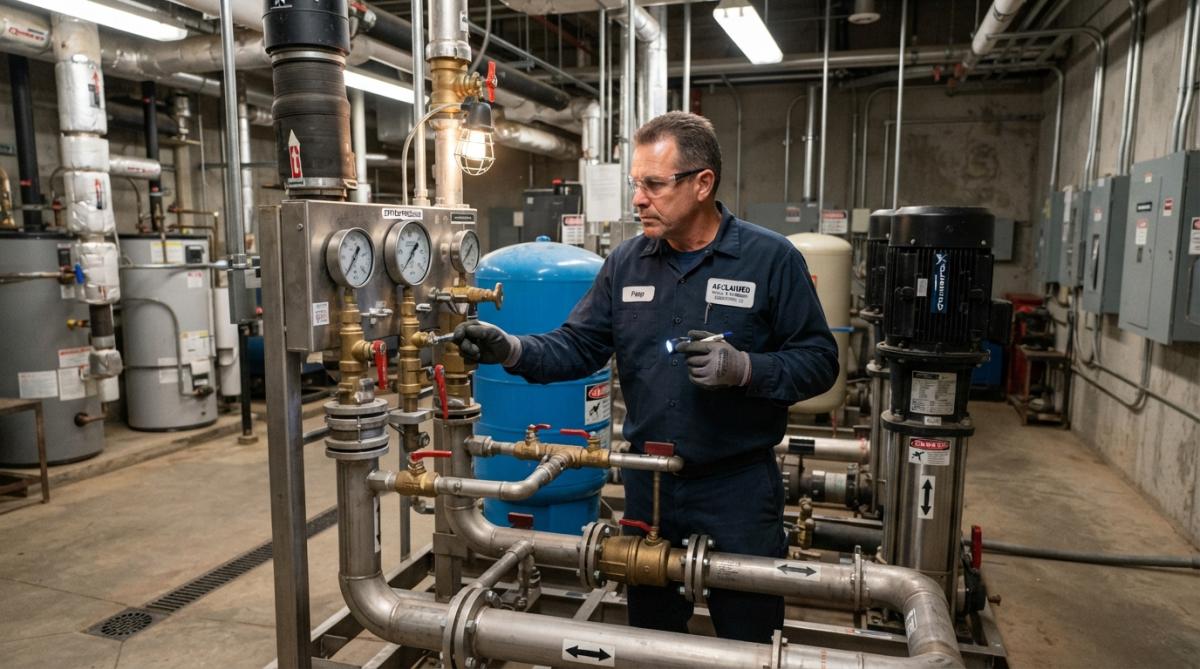
A pressure boosting system solves low-pressure problems by adding mechanical force to the water supply. Instead of relying solely on municipal pressure, the system uses pumps to increase flow and maintain consistent pressure throughout the building.
How VFD-controlled booster pumps maintain hydraulic stability
VFD stands for Variable Frequency Drive. These pumps adjust speed automatically based on demand, maintaining constant pressure without the waste of traditional fixed-speed pumps. When demand is low, the pump slows down. When demand spikes, it speeds up. This responsive behavior prevents pressure swings and reduces energy consumption.
Hydraulic stability matters because consistent pressure protects infrastructure. Fluctuating pressure stresses pipes, fittings, and fixtures. VFD pumps eliminate those swings by matching output to real-time demand. The result is steady pressure at every floor and fixture, ensuring water pressure reliability across the entire facility.
VFD systems also reduce operating costs. Fixed-speed pumps run at full capacity regardless of demand, wasting energy during low-use periods. VFD pumps consume energy proportional to actual flow, cutting electricity use significantly. Over a year, the energy savings offset a substantial portion of the system’s initial cost.
Redundancy and reliability in system design
A single pump is a single point of failure. If it breaks, the entire building loses pressure boosting. Professional system design includes redundant pumps: two or more pumps working in parallel, each capable of handling full demand independently.
Redundancy keeps facilities operational during maintenance. One pump can be serviced while the other maintains pressure. For hospitals, data centers, and other critical facilities, redundancy is non-negotiable. It prevents service interruptions that could harm operations or safety.
Pressure tanks complement pump redundancy. These tanks store pressurized water, acting as a buffer. During peak demand, the tank releases stored water, reducing the load on pumps. During low-demand periods, pumps refill the tank. Tanks smooth pressure fluctuations and extend pump life by reducing start-stop cycling.
Commercial Water Booster Pump Systems: Installation and ROI
Installing a commercial water booster pump system requires professional planning and execution. The investment pays dividends in improved water pressure and reliability, reduced emergency repairs, and lower operating costs.
Payback period and operating cost analysis
System cost depends on building size, required flow rate, and complexity. A small commercial building might need a modest system; a large multi-story facility requires more capacity and redundancy. Professional evaluation determines the right sizing.
Operating costs include electricity for pump operation, maintenance, and eventual replacement. VFD systems reduce electricity use compared to fixed-speed alternatives. Maintenance costs are predictable: annual inspections, filter changes, and occasional repairs. The payback period, how long until energy savings cover the initial investment, depends on the specific system and building.
Beyond the payback period, the system continues generating savings. Reduced water waste, fewer emergency repairs, and extended equipment life add value. Facilities that upgrade report fewer tenant complaints about pressure, reduced maintenance calls, and improved system reliability. Consistent performance across diverse supply sources remains a priority, and specialized techniques to improve well water pressure ensure that even remote sites maintain the same operational standards as municipal connections.
Claim Your Free Estimate Today →
Integration with Building Management Systems
Modern buildings use Building Management Systems (BMS) to control HVAC, lighting, security, and other infrastructure. Integrating the water pressure system with the BMS enables centralized monitoring and control.
BMS integration provides real-time visibility into water pressure, flow rate, pump status, and energy consumption. Facility managers monitor performance from a central dashboard.
Commercial Plumbing Maintenance Checklist for Water System Health
Regular maintenance prevents pressure problems and extends system life. A structured checklist ensures nothing is overlooked.
Pressure tank inspection and pressure regulator testing
Pressure tanks require annual inspection. Check the tank for corrosion, leaks, or structural damage. Drain sediment from the bottom to maintain water quality. Test the air charge, the pressurized air inside the tank that helps regulate pressure. Low air charge reduces tank effectiveness and should be corrected immediately.
Leak detection and pipe integrity assessment
Leaks waste water and reduce pressure. Walk the facility regularly, listening and looking for signs of leaks: wet spots, mold, water stains, or the sound of running water when fixtures are off. Small leaks detected early are cheaper to repair than large ones discovered later.
Smart Water Management and IoT Monitoring
IoT sensors and smart monitoring systems transform water management from reactive to proactive. Real-time data reveals patterns and problems before they escalate.
Remote monitoring for early warning signs
IoT sensors measure pressure, flow, temperature, and water quality at multiple points in the building. Data streams to a cloud-based dashboard accessible from any device. Facility managers see system performance in real time, even from off-site.
Water consumption tracking and efficiency optimization
Smart meters track water consumption by zone or floor. This granular data reveals where water is used and where waste occurs. A floor consuming far more water than similar floors might have a hidden leak or inefficient fixtures.
Water Efficiency and Infrastructure Protection
Water efficiency and system reliability are interconnected. Efficient systems stress infrastructure less, extending equipment life and reducing failures.
Regulatory compliance and safety standards
The International Building Code (IBC) and local plumbing codes establish minimum standards for water supply systems. These codes address pressure requirements, pipe sizing, backflow prevention, and safety devices. Compliance is mandatory and protects public health.
Preventative maintenance to reduce emergency response costs
Preventative maintenance is far cheaper than emergency repair. A small leak fixed during scheduled maintenance costs a fraction of the water damage and emergency service call required if it goes undetected.
| Maintenance Task | Frequency | Impact |
|---|---|---|
| Pressure gauge check | Monthly | Detects pressure drift early |
| Tank sediment drain | Quarterly | Maintains water quality |
| Regulator testing | Annually | Confirms pressure control |
| Relief valve test | Annually | Ensures safety |
| Professional assessment | Every 2-3 years | Identifies hidden problems |
| Pipe inspection | Annually | Catches corrosion early |
Strategic Water Management for Facility Managers
Water pressure and reliability are not one-time fixes. They require ongoing attention and strategic planning. Facility managers who treat water systems as critical infrastructure outperform those who ignore them until failure.
Frequently Asked Questions
What causes low water pressure in large commercial buildings?
Low water pressure in multi-story buildings stems from distance from the municipal supply, peak demand during business hours overwhelming the system, aging pipe infrastructure that restricts flow, or failing pressure regulators. Static pressure drops as water travels upward through floors. In older facilities, mineral buildup and corrosion inside pipes reduce effective diameter, strangling flow rate. A professional diagnostic using pressure testing equipment identifies whether the issue originates from the municipal supply, your internal infrastructure, or equipment failure.
How can facility managers improve water pressure and reliability?
Install a pressure boosting system with VFD-controlled pumps that automatically adjust output based on demand, maintaining consistent hydraulic stability throughout the building. Pair this with redundant pump capacity so one unit can sustain operations if the other fails. Implement a preventative maintenance schedule that includes quarterly pressure tank inspection, pressure regulator testing, and leak detection. Add IoT monitoring to track real-time pressure and flow rate, triggering alerts before problems cascade into system stress or emergency response situations.
What is a commercial water booster pump system and why does it matter?
A booster pump system increases pressure and flow rate to serve multi-story buildings or facilities with high peak demand. VFD technology makes these systems energy-efficient by modulating pump speed to match actual demand rather than running at full capacity constantly. Redundancy, having two pumps instead of one, protects against downtime. The ROI becomes clear through reduced utility performance issues, fewer emergency repairs, and lower water consumption. Integration with your Building Management System enables remote monitoring and automated alerts.
How often should commercial plumbing systems be inspected?
Quarterly inspections form the foundation of a solid preventative maintenance program. Each check should include pressure tank condition, pressure regulator function, leak detection via visual inspection and acoustic monitoring, and pipe integrity assessment in visible sections. Annual sewer camera inspection of drain lines catches root intrusion and structural failure before they force emergency response. For facilities over 20 years old or with recurring pressure issues, more frequent inspections can help prevent costly infrastructure failure and maintain system optimization.
