
Claim Your Free Estimate Today

Table of Contents
- What Is Hydro Jetting and How It Works for Commercial Kitchen Drains
- Benefit 1: Eliminates Grease Accumulation and Drain Line Blockage
- Benefit 2: Prevents Operational Downtime and Emergency Repairs
- Benefit 3: Extends Plumbing Infrastructure and Pipe Longevity
- Benefit 4: Chemical-Free Cleaning and Environmental Compliance
- Benefit 5: Maintains Health Code Compliance and Sanitation Standards
- Hydro Jetting vs. Plumbing Snake: Which Method Works Best
- Commercial Kitchen Drain Maintenance Schedule and Hydro Jetting Frequency
- Frequently Asked Questions
Last Updated: September 18, 2026
What Is Hydro Jetting and How It Works for Commercial Kitchen Drains
Hydro jetting is a high-pressure water cleaning method that uses a powerful stream of water to clear drain line blockages and restore drainage efficiency in commercial kitchen plumbing systems, and understanding the 5 benefits of hydro jetting for commercial kitchens helps restaurant owners make informed maintenance decisions. Unlike traditional drain snaking, which mechanically breaks through clogs, hydro jetting forces water at pressures between 3,000 and 4,000 PSI through pipes to scour pipe walls and remove accumulated grease, sludge, and food debris.
The pressurized water stream dislodges mineral deposits, breaks apart grease accumulation, and flushes debris toward the main sewer line, eliminating the root cause rather than just clearing a temporary blockage.
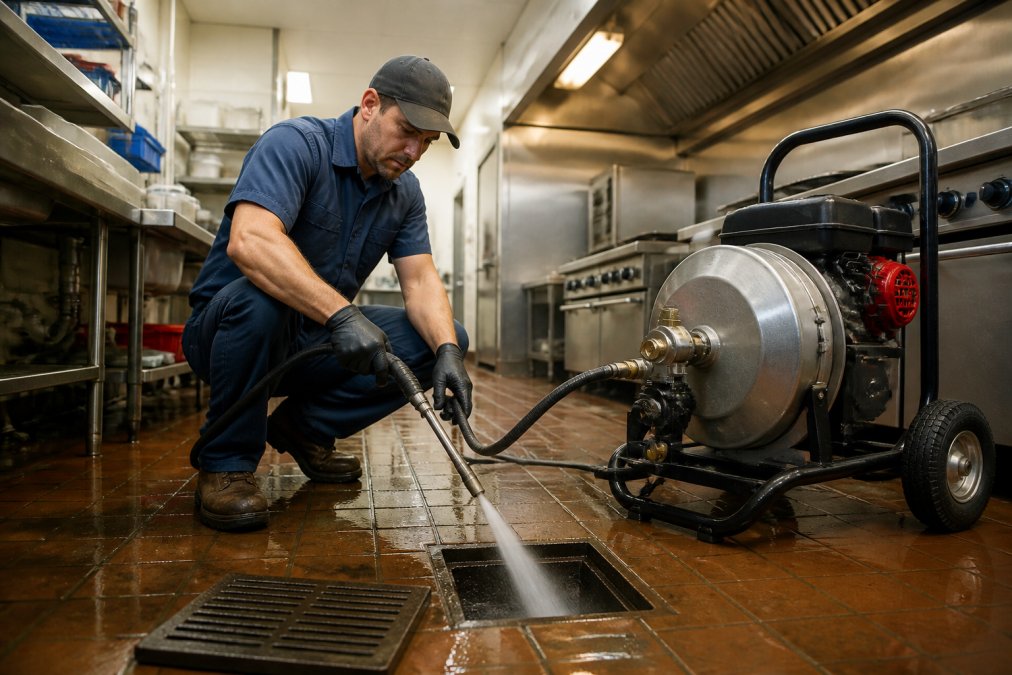
At Acclaimed Drain And Plumbing Solutions, LLC, we use hydro jetting as a core drain cleaning service because it addresses the specific challenges commercial kitchens face. Fats, oils, and grease (FOG) coat pipe interiors over time, creating a sticky surface where food debris accumulates. Standard drain snaking can punch through the immediate blockage, but leaves residual buildup behind. Hydro jetting cleans the entire pipe wall, restoring full diameter capacity and preventing rapid re-clogging.
These advantages represent the core 5 benefits of hydro jetting for commercial kitchens: a single hydro jetting session extends the time between maintenance visits significantly, reducing operational downtime and emergency repair costs for restaurant owners and facility managers.
Benefit 1: Eliminates Grease Accumulation and Drain Line Blockage
The primary benefit of hydro jetting for commercial kitchens is its ability to eliminate grease accumulation that conventional methods leave behind. Grease bonds to pipe walls, creating a sticky substrate where food particles, mineral deposits, and other debris accumulate over time.
A plumbing snake punches a hole through the blockage but leaves the grease coating intact, so new debris sticks to that surface within weeks or months. Hydro jetting removes the grease entirely, leaving bare pipe wall that resists rapid re-clogging.
The high-pressure water stream scours every inch of the pipe interior, breaking the bond between grease and metal and reaching areas a mechanical snake cannot.
Pro Tip
Schedule hydro jetting before grease accumulation becomes severe. Once blockage happens, you’re already facing operational downtime. Preventative maintenance is faster and cheaper than emergency repair.
Schedule hydro jetting before grease accumulation becomes severe. Once blockage happens, you’re already facing operational downtime. Preventative maintenance is faster and cheaper than emergency repair.
For restaurants with high-volume cooking, grease accumulation happens continuously from fryers, griddles, and steam tables. Without regular hydro jetting, blockage progresses from slow drainage to complete backup, sometimes forcing temporary kitchen closure.
Benefit 2: Prevents Operational Downtime and Emergency Repairs
A backed-up drain means you can’t wash dishes, can’t drain cooking equipment, and may face health code violations that force closure. Hydro jetting prevents emergency repairs by maintaining clear drainage capacity before problems develop.
Emergency repairs cost significantly more than scheduled maintenance due to immediate dispatch, after-hours labor, and urgency charges, plus lost revenue and potential health code penalties.
Preventative maintenance through regular hydro jetting keeps drains flowing freely. When you schedule hydro jetting on a maintenance cycle rather than waiting for failure, you control timing, reduce service costs, and avoid the chaos of an unexpected shutdown.
Watch Out
Ignoring slow drainage is a common mistake. By the time you notice backup, you’re already at risk. Grease accumulation progresses silently until suddenly the drain stops working entirely.
Ignoring slow drainage is a common mistake. By the time you notice backup, you’re already at risk. Grease accumulation progresses silently until suddenly the drain stops working entirely.
Consistent drainage means your dishwashing station functions at full capacity, your prep area stays sanitary, and your staff can work without worrying about water backup.
Benefit 3: Extends Plumbing Infrastructure and Pipe Longevity
Hydro jetting extends plumbing infrastructure lifespan by removing corrosive materials. Grease accumulation creates an acidic environment as bacteria break down FOG, corroding pipe walls over time.
Allowing sludge removal only during emergency repairs accelerates pipe deterioration and corrosion, leading to pinhole leaks, cracks, and eventual replacement. Hydro jetting removes corrosive material before it damages the pipe.
Regular hydro jetting extends the useful life of your plumbing system by several years, potentially delaying full repiping projects.
The cost difference is substantial. A full sewer line replacement or structural pipe rehabilitation is a major capital project. Regular hydro jetting costs far less and keeps your existing pipes functioning. For property managers overseeing multiple commercial buildings, this translates to better budget predictability and fewer surprise major repairs.
Claim Your Free Estimate Today →
Benefit 4: Chemical-Free Cleaning and Environmental Compliance
Hydro jetting is a chemical-free cleaning method, which means it complies with environmental regulations and wastewater management standards without requiring hazardous drain cleaners. Many commercial drain cleaners contain caustic or acidic chemicals that are corrosive, toxic, and regulated for disposal.
High-pressure water eliminates the need to handle, store, and dispose of hazardous materials, simplifying environmental compliance and reducing liability.
Key Takeaway
Chemical-free hydro jetting aligns with modern environmental standards and reduces regulatory complexity for commercial kitchen operators.
Chemical-free hydro jetting aligns with modern environmental standards and reduces regulatory complexity for commercial kitchen operators.
Benefit 5: Maintains Health Code Compliance and Sanitation Standards
Health code compliance is non-negotiable for commercial food service operations, and drainage maintenance is a direct regulatory requirement. The FDA Food Code, adopted by most state and local health departments, explicitly requires that food service establishments maintain effective drainage systems to prevent contamination and backup of wastewater into food preparation areas.
- Critical violations that may force immediate closure until corrected
- Fines ranging from $500 to $5,000+ depending on jurisdiction and violation severity
- Points deductions on inspection scores that affect your establishment’s public rating
- License suspension if violations are not remedied within the specified timeframe
Key Takeaway
Health code compliance requires documented drainage maintenance. Hydro jetting records prove to inspectors that you meet FDA Food Code Section 5-501.115 and reduce the risk of critical violations and fines.
Health code compliance requires documented drainage maintenance. Hydro jetting records prove to inspectors that you meet FDA Food Code Section 5-501.115 and reduce the risk of critical violations and fines.
Hydro Jetting vs. Plumbing Snake: Which Method Works Best
The choice between hydro jetting and drain snaking depends on the severity of the blockage and your maintenance goals. A plumbing snake works well for acute blockages, something got stuck and you need it out now. Hydro jetting works better for chronic issues and preventative maintenance.
When to use a plumbing snake:
- Immediate blockage from a specific object (food debris, grease ball)
- Quick, temporary clearing for emergency situations
- Lower upfront cost for one-time clearing
When to use hydro jetting:
- Recurring drain problems in the same location
- Preventative maintenance to extend time between cleanings
- Grease accumulation in commercial kitchens
- Full pipe wall cleaning to restore drainage efficiency
| Method | Best For | Cost Profile | Effectiveness | Preventative Value |
|---|---|---|---|---|
| Plumbing Snake | Emergency blockage removal | Lower per-call | Clears blockage temporarily | Low, residue remains |
| Hydro Jetting | Preventative maintenance | Higher per-call | Removes grease and debris completely | High, extends time between cleanings |
Commercial Kitchen Drain Maintenance Schedule and Hydro Jetting Frequency
Hydro jetting frequency depends on your kitchen’s FOG (fats, oils, and grease) generation rate, which correlates directly to cooking equipment and volume. A high-volume restaurant with multiple fryers, griddles, and steam tables generates significantly more FOG than a smaller café, requiring more frequent maintenance.
Typical hydro jetting schedules by kitchen type:
- High-volume kitchens (full-service restaurants, institutional cafeterias): Every 3-4 months
- Medium-volume kitchens (casual dining, limited-service): Every 6-8 months
- Lower-volume kitchens (small cafés, catering prep areas): Every 12 months
Integrating Hydro Jetting with Grease Trap Maintenance
The optimal maintenance cycle coordinates both services:
- Establish a grease trap pumping schedule based on your local health department requirements and your kitchen’s actual usage (most jurisdictions require documentation of pumping frequency)
- Schedule hydro jetting at intervals that match your FOG generation rate, informed by your initial camera inspection
- Monitor drain performance between scheduled services; if you notice slow drainage before the next scheduled hydro jetting, accelerate the schedule
- Document all maintenance for health inspections and to track whether your current frequency is adequate
Cost-Benefit Analysis: Preventative Hydro Jetting vs. Emergency Repair
- Scheduled hydro jetting: $300-$600 per service, performed during business hours or planned downtime
- Emergency drain repair: $800-$1,500+ per service, often with after-hours labor premiums and urgency charges
- Lost revenue from kitchen closure: $500-$5,000+ per hour, depending on your restaurant’s volume and covers
- Health code violation fines: $500-$5,000+ if backup is discovered during inspection
Best For
Restaurants with high cooking volume and multiple grease-producing equipment benefit from quarterly hydro jetting coordinated with grease trap pumping every 4-8 weeks. This two-part approach prevents 90% of emergency drain problems.
Restaurants with high cooking volume and multiple grease-producing equipment benefit from quarterly hydro jetting coordinated with grease trap pumping every 4-8 weeks. This two-part approach prevents 90% of emergency drain problems.
Frequently Asked Questions
What are the main benefits of hydro jetting for commercial kitchens?
Hydro jetting removes grease accumulation, sludge, and food debris that cause drain line blockage. It restores drainage efficiency, prevents costly emergency repairs, and extends plumbing infrastructure lifespan. Unlike chemical cleaners, it’s environmentally safe and helps kitchens maintain health code compliance without damaging older pipes.
How does hydro jetting compare to using a plumbing snake?
A plumbing snake mechanically breaks through clogs but often leaves grease residue and mineral deposits on pipe walls, leading to recurring blockages. Hydro jetting uses high-pressure water to scour the entire pipe interior, removing 99% of debris and restoring full pipe diameter. For commercial kitchens with heavy grease buildup, hydro jetting provides longer-lasting results and prevents future clogs more effectively than snaking alone.
How often should a commercial kitchen schedule hydro jetting?
Most commercial kitchens benefit from quarterly or semi-annual hydro jetting as part of a preventative maintenance program. High-volume restaurants with heavy grease production may need monthly service. A professional inspection with sewer camera technology can determine the right schedule for your specific operation, helping you avoid emergency shutdowns and unexpected repair costs.
Is hydro jetting safe for older commercial plumbing pipes?
Yes, when performed by licensed professionals. Modern hydro jetting systems can adjust pressure levels based on pipe material and condition. A pre-service camera inspection identifies any weak spots or structural issues before jetting begins. This preventative approach is far safer than allowing grease buildup to cause sewer backups or pipe damage, which often forces expensive emergency replacement.
What is the typical cost of hydro jetting for a restaurant, and does it provide good ROI?
Hydro jetting costs vary based on line length, blockage severity, and accessibility, so contact a licensed plumber for an accurate quote. The ROI is strong: preventing even one emergency sewer backup (which can cost thousands and force temporary closure) typically pays for multiple preventative hydro jetting services. Scheduled maintenance also reduces overall plumbing repair costs and protects your restaurant’s reputation by eliminating drainage problems that affect operations.
